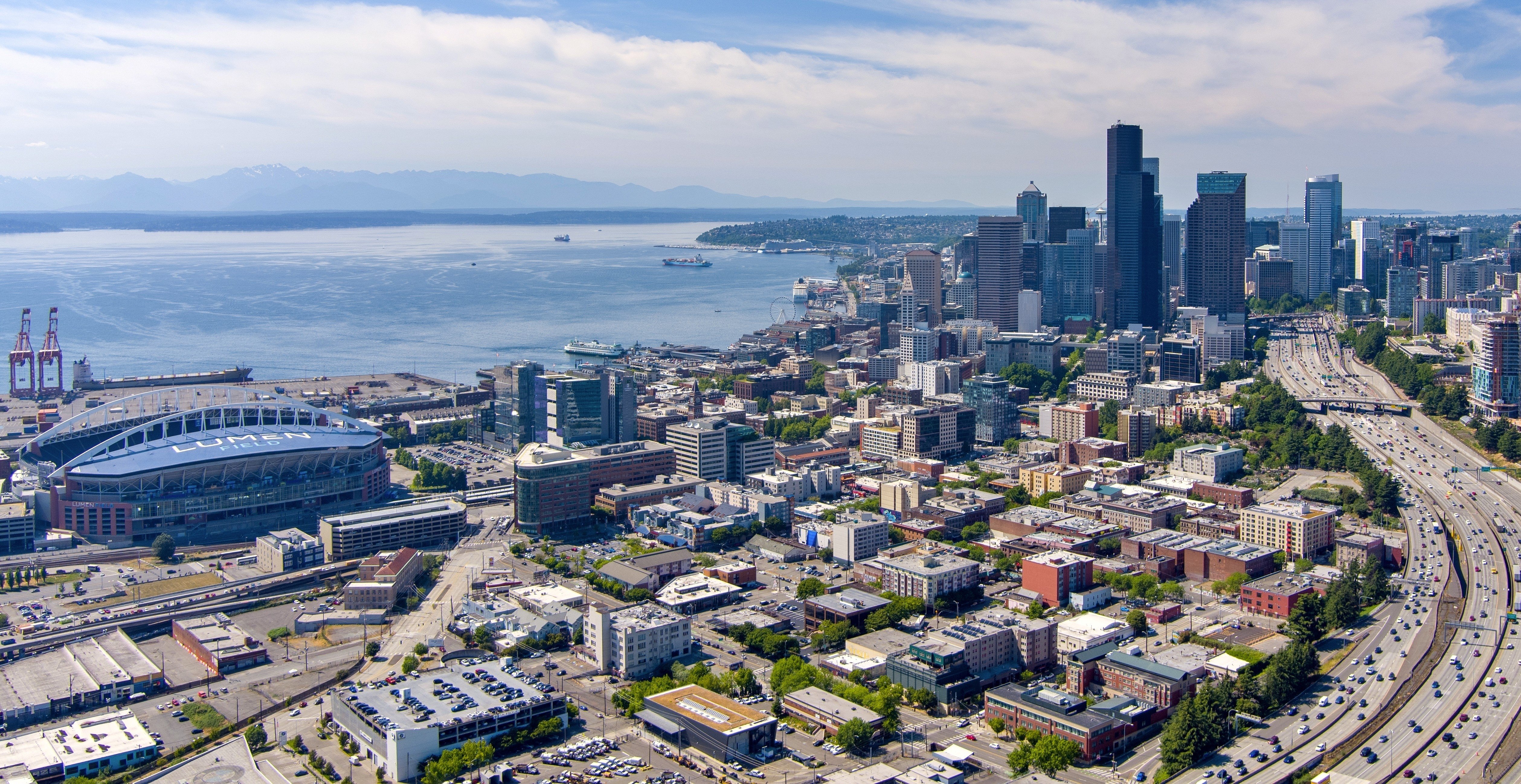
Every four years, the World Cup arrives and the professional world (at least its soccer fans) quietly adjusts its rhythm. Emails go unanswered a little longer, meetings run slightly shorter, and the office kitchen TV becomes prime real estate. This summer, the tournament is jointly hosted by Canada, Mexico, and the United States, but this analysis focuses only on U.S. stadium locations. Within that scope, the competition spans 11 American cities over 48 days and 78 games, significantly changing the disruption calculus.
A UKG survey of 8,000 workers across eight countries found that one-third of them expect to take at least one day off due to the World Cup, with one-quarter planning to miss part of a workday regardless.
With that in mind, CoworkingCafe mapped the flexible workspace landscape around each of the eleven host stadiums by counting coworking spaces within a three-mile radius of each venue; measuring day pass prices; cross-referencing transit costs; and calculating the cultural amenity density that makes some cities feel like a destination and others feel like a logistics exercise.
We found that Kansas City’s Arrowhead Stadium, host of six games at the tournament, returned no coworking spaces within the three-mile radius. Having this sports arena excluded from the comparative analysis, we are left with ten host stadiums to talk about.
What we found is a story of two halves. Four stadiums sit inside the cities that host them, surrounded by coworking infrastructure that makes flexible work genuinely easy, whereas the other six sit in suburbs, industrial corridors or satellite towns where the coworking count near the venue drops to almost nothing.
Key Takeaways:
- Urban stadiums have 6× more coworking spaces within 3 miles than suburban stadium venues.
- Houston emerges as the most remote-work-friendly World Cup host city.
- Major “big-name” cities often lack coworking access near their stadiums.
- The World Cup 2026 is becoming a workplace event, not just a sports event.
Urban Stadiums Have 6x More Coworking Options
We identified a total of 165 coworking spaces within three miles of the ten host stadiums combined. That number alone tells part of the story, but it breaks apart sharply once you separate stadiums by whether they actually sit inside the cities that represent them.
For example, four stadiums are genuinely urban: Atlanta’s Mercedes-Benz Stadium, Houston’s NRG Stadium, Philadelphia’s Lincoln Financial Field, and Seattle’s Lumen Field. These four venues are within their host cities, and the three-mile radius around each one reflects an average of 33 coworking spaces per stadium.
In contrast, six stadiums are not in the cities they represent: AT&T Stadium (Arlington), Gillette Stadium (Foxborough), SoFi Stadium (Inglewood), Hard Rock Stadium (Miami Gardens), MetLife Stadium (East Rutherford), and Levi’s Stadium (Santa Clara). The average number of coworking spaces within three miles of these six venues is 5.5.
Thirty-three versus 5.5. If you’re a remote worker planning around a game, that difference is the whole ballgame.
The Suburban Penalty, City by City
Every city tells a different version of the same story. Boston is the most extreme case: 65 coworking spaces across the city, but only one within three miles of Gillette Stadium in Foxborough. For those passionate about statistics, that’s a 98.5% drop from city to venue. Miami and Dallas are nearly identical to each other: both cities count 89 spaces, both drop to four near their respective stadiums, a 95.5% reduction in each case. Los Angeles loses 92.6% of its coworking inventory when you zoom in on SoFi Stadium in Inglewood. MetLife Stadium’s East Rutherford location carries an 83.3% penalty against Jersey City.
Notably, San Francisco is the least severe of the suburban cases. Fourteen coworking spaces sit within three miles of Levi’s Stadium (more than any other suburban venue in the analysis) which reflects the density of Silicon Valley’s commercial infrastructure around Santa Clara rather than anything to do with San Francisco itself. The stadium is forty miles south of the city it supposedly represents.
The urban four tell the opposite story, of course. Atlanta, Houston, Philadelphia, and Seattle all have zero penalty. The stadium is in the city and the coworking spaces that serve it also serve the neighborhood around the venue, so what you see on the map is what you get on game day.
Atlanta & Houston: Two Cities That Just Work
Atlanta leads the entire analysis by the measure that matters most for working fans: coworking spaces within three miles of the stadium. With Mercedes-Benz Stadium in the heart of Midtown, 53 spaces fall within that radius, and every one of them accessible from the same transit network that gets fans to the game. Here, MARTA runs $2.50 for a single ride with four transfers across modes, or $9 for a day pass. Meanwhile, day passes at Atlanta coworking spaces run a median of $40. So, your entire working day, including getting to the stadium for an afternoon game, costs less than $50 before you’ve even bought a beer.
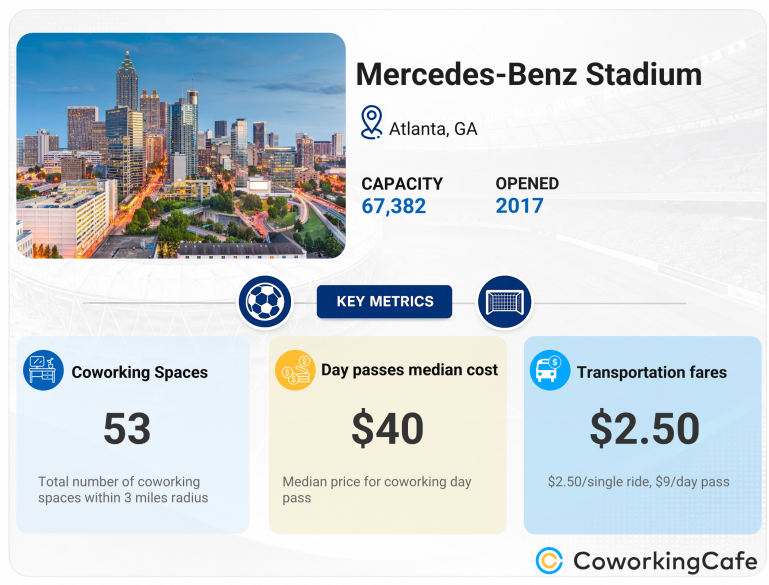 Atlanta also ranks second in the analysis for coworking density with nearly 25 spaces per 100,000 residents. It’s a figure that reflects both the city’s genuine adoption of flexible workspace and its relatively compact geography.
Staying in the South, Houston runs a different kind of operation. In this case, NRG Stadium is on the south side of the city and squarely within Houston‘s sprawling footprint. The result is 16 coworking spaces within three miles of the venue.
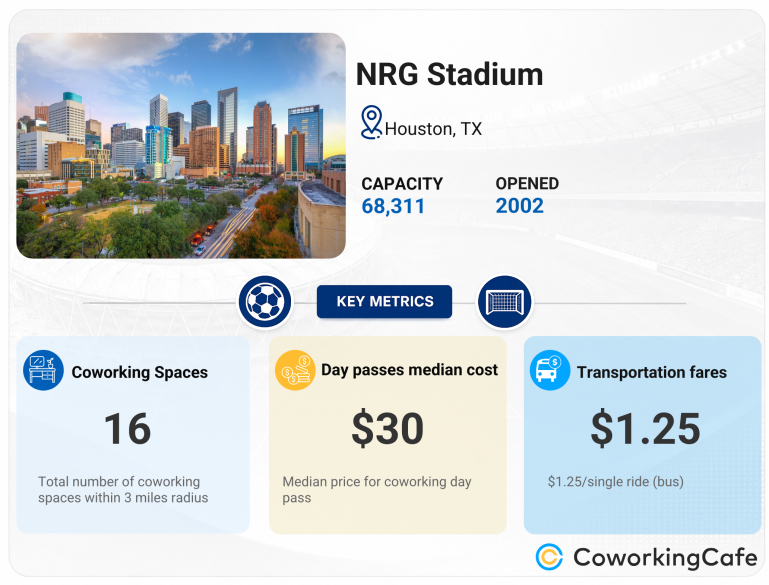 Houston also offers the cheapest transit in the study: $1.25 for a single bus ride, with no day pass cap complicating the math. Then, if you add a $30 median day pass, a full working day in Houston costs just $31.25. That’s less than the parking surcharge at MetLife Stadium on game days. Clearly, Houston is the tournament’s best-kept logistical secret, a city with serious coworking infrastructure that rarely gets credit for it because the national flex workspace conversation tends to orient around coastal areas.
Philadelphia & Seattle: Underrated & Underpriced
Philadelphia deserves more attention than it typically gets in conversations about flex workspace. That’s because Lincoln Financial Field sits inside the city in South Philly and 19 coworking spaces fall within three miles of the venue. Plus, the median day pass is $32, one of the lowest in the analysis.
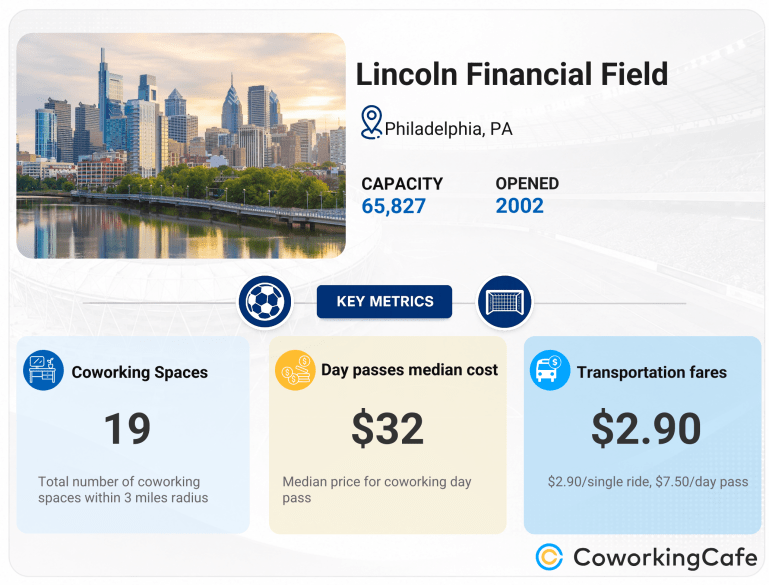 And, SEPTA runs $2.90 for a single ride (which includes two transfers within two hours), or $7.50 for a day pass. Asyou can see, Philadelphia is a combination of price, density, and transit access that competes comfortably with Atlanta and Houston for the title of best market for the working World Cup fan.
Likewise, Seattle’s Lumen Field sits in the SODO neighborhood, which is directly accessible from the Link Light Rail with no special event surcharge. Here, 44 coworking spaces fall within three miles (the second highest of any host stadium in the analysis), day passes run $39, and transit costs $3 per ride. Seattle also ranks fourth in cultural amenity density at nearly 480 per 100,000 residents.
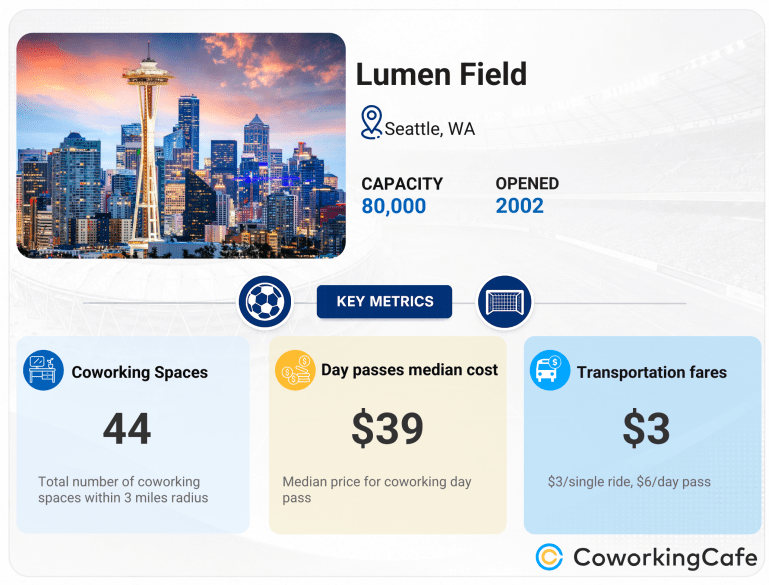 So, for a working professional traveling to Seattle for games and needing a productive environment between games, the workspace infrastructure is genuinely solid.
Dallas: Strong City, Suburban Stadium
Dallas presents the sharpest version of the stadium-suburb tension under the three-mile radius. In fact, AT&T Stadium in Arlington, Texas, is one of the most recognizable venues in American sports, despite being roughly 20 miles west of downtown, and at this radius only four coworking spaces sit within reach of the venue (95.5% drop from the city’s 89-space count), the joint steepest suburban penalty in the analysis alongside Miami.
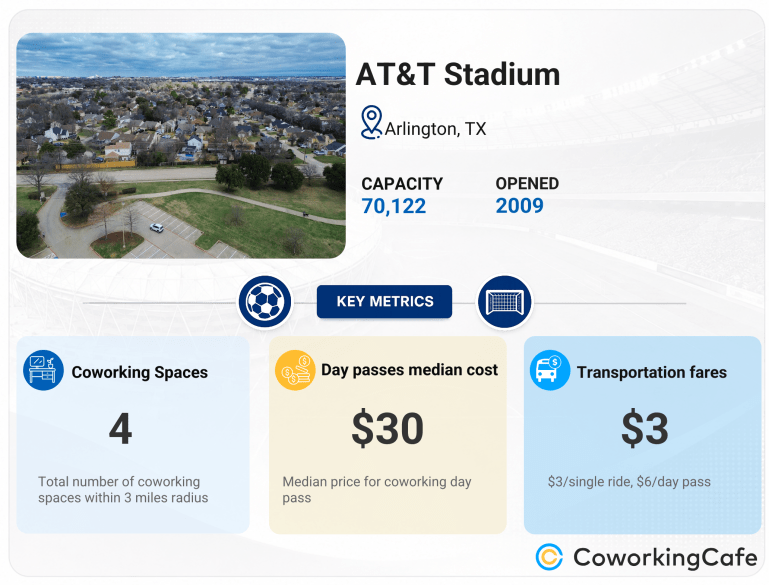 That said, the broader Dallas coworking scene is genuinely strong. 89 spaces across the city, day passes at $30, DART transit running $3 per single ride with three hours of unlimited rides on that fare. The city’s coworking density per 100,000 residents sits at 6.8.
Therefore, for clash days at AT&T Stadium, the practical strategy is to work from a central Dallas coworking space in the morning and make the drive or rail connection to Arlington when the schedule calls for it. The coworking infrastructure in the city supports that approach, but the stadium’s immediate neighborhood does not.
Miami: Most Expensive & Most Alive
Miami is the outlier on both ends of the dataset. First, day passes at $47 are the highest in the analysis, reflecting both the city’s premium positioning in the national coworking market and the sustained wave of business relocations that pushed south. Additionally, the cultural amenity density is almost 952 per 100,000 residents, or about one-third higher than Atlanta’s second-place figure of 712, as well as nearly six times Los Angeles’s 163. Granted, Miami is the most culturally dense host market in the tournament, and it prices accordingly.
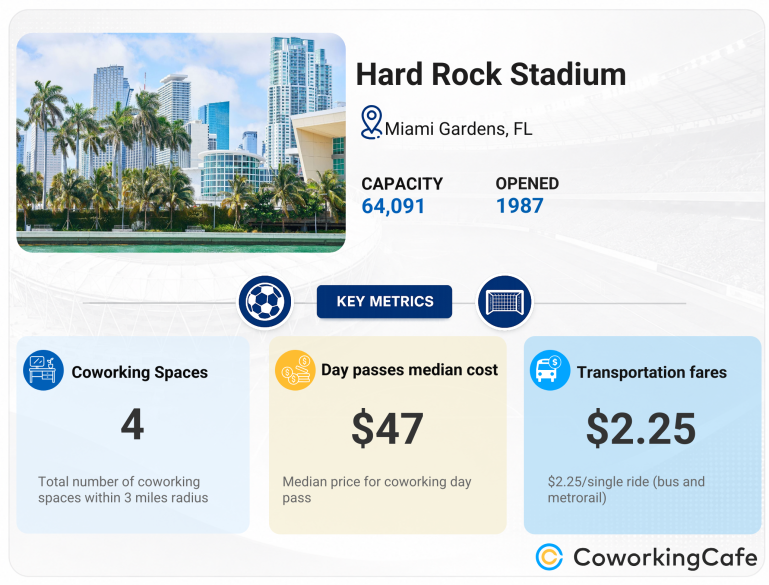 Hard Rock Stadium sits in Miami Gardens, FL, which is roughly 12 miles north of downtown, and the suburban penalty applies: It claims only four coworking spaces within three miles of the venue, against a total of 89 across the city (a 95.5% drop that matches Dallas for the steepest in the analysis). At the same time, Miami-Dade’s transit network runs $2.25 per single ride on both bus and Metrorail.
With that, the practical reality for a working fan in Miami is that it’s a city with extraordinary ambient energy and genuine workspace infrastructure that requires some intention to access from the stadium’s neighborhood. Even so, book a desk in Brickell, Wynwood, or the Design District, build your workday around the commute, and treat the game as the afternoon’s main event.
Los Angeles: Big City, Long Distances
Los Angeles is the most populated host market with more than 3.8 million residents, as well as the least coworking-dense by per-capita measure at 2.4 spaces per 100,000 people, a function of scale more than absence. Here, 94 spaces serve The City of Angels, but only seven fall within three miles of SoFi Stadium in Inglewood (a 92.6% drop that tells you everything about how this city is organized).
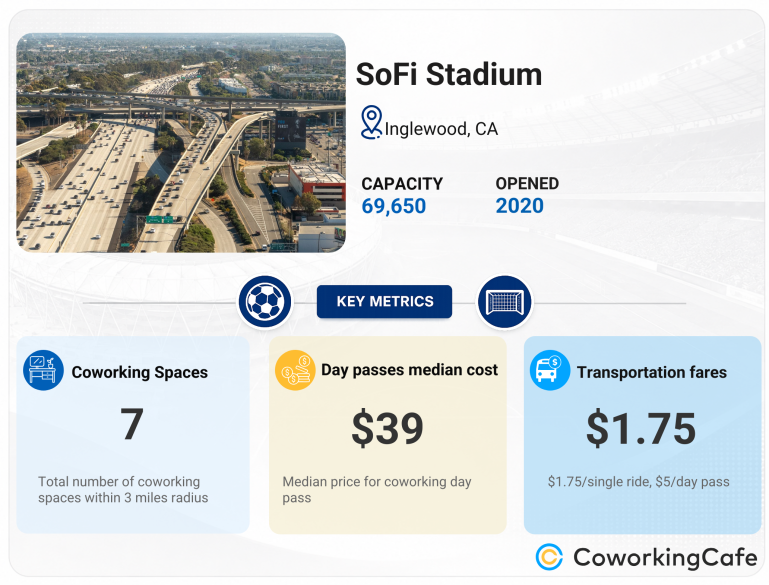 Furthermore, transit runs $1.75 per single ride with free transfers for two hours, and Metro’s K Line now connects downtown to Inglewood, which changes the accessibility calculation meaningfully. Otherwise, day passes at $39 put Los Angeles in the middle of the cost range. Thus, the working strategy here is the same as it is in most of LA: Pick your neighborhood and find a coworking space that serves it.
Boston: 30 Miles Is 30 Miles
Gillette Stadium in Foxborough, MA, has hosted championship events for 30 years, and it has never been easy to reach. It’s 30 miles south of Boston, and the transit options for game days have become a national story in their own right with express buses running $95 round-trip and commuter rail tickets at $80 round-trip, four times the normal game-day fare. Plus, only one coworking space sits within three miles of the stadium (the lowest of any host venue in the entire analysis), and a 98.5% drop from the 65 spaces across greater Boston. The day passes are reasonable at $40 , but none of that matters much if you need to be near the venue.
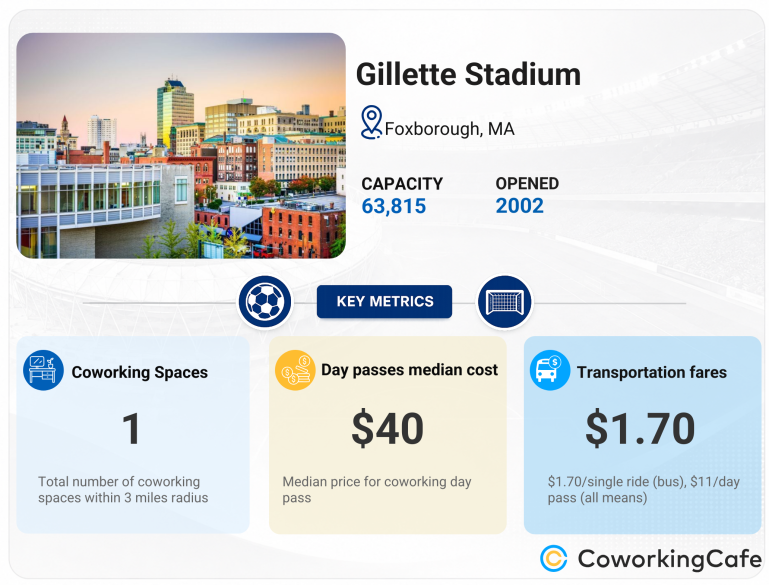 However, the Boston market rewards a simple split: Work in the city, travel to the game. Specifically, Seaport, Back Bay, and Cambridge have solid coworking options so you can find a space and put in your hours before heading to Foxborough. In this area, the stadium is not where your workday happens and that’s perfectly fine. But, the post-game commute back is a different problem.
New York/New Jersey: The Tournament’s Most Complicated Market
MetLife Stadium in East Rutherford, NJ, hosts eight games including the July 19 final, and no venue in the tournament has generated more logistical conversation. That’s because NJ Transit announced round-trip rail tickets from Manhattan’s Penn Station will cost $150 per person per game, which is nearly 12 times the normal $12.90 fare for a 15-minute ride. What’s more, on-site parking has been eliminated for most ticket holders. As such, the 5,000 parking spots at the nearby American Dream Mall run $225 per spot.
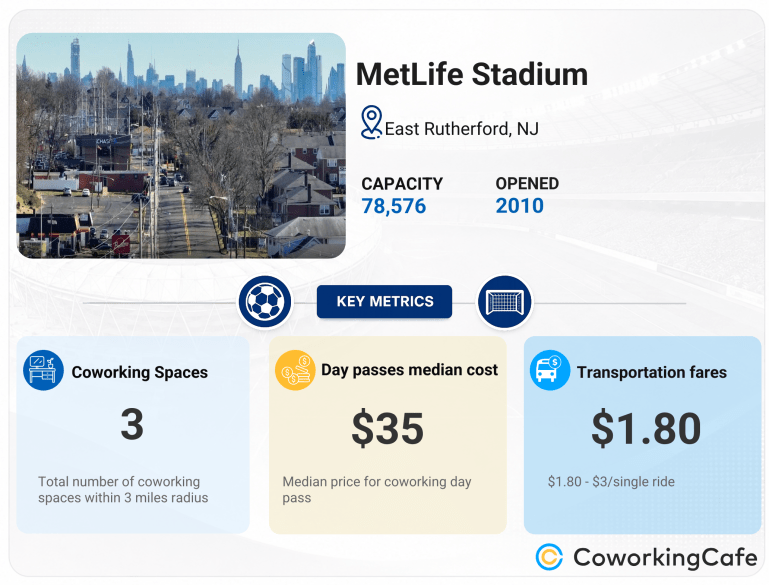 Otherwise, Jersey City has 18 coworking spaces and three sit within three miles of MetLife Stadium in East Rutherford (an 83.3% decrease). Day passes run $35, and NJ Transit regular fares are $1.80 to $3 per single ride.
San Francisco: Premium Everything, Including the Gap
San Francisco has 85 coworking spaces and some of the strongest per-capita workspace infrastructure in the country, but the stadium is not in San Francisco. Here, Levi’s Stadium is in Santa Clara, CA, 40 miles south, and this is where the framing shifts. This is Silicon Valley, and the professionals traveling for this game may have office access options that never show up in coworking data.
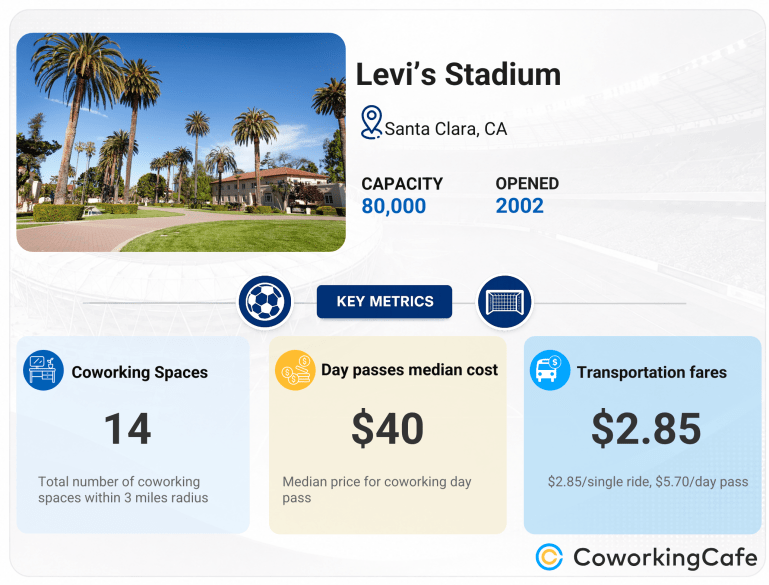 For everyone else, the picture is more nuanced than other suburban venues: fourteen coworking spaces sit within three miles of Levi’s Stadium, the highest count of any suburban stadium in the analysis, which reflects the commercial density of Santa Clara and the broader Silicon Valley corridor rather than anything San Francisco contributes.
If you are attending the game, the numbers are simple: the game is in Santa Clara, not in San Francisco, and that forty-mile distance has a price. Getting there on Caltrain runs $10 to $15 round-trip, and at $4.10 this market carries the highest average transportation cost in the entire analysis. Moreover, day passes near the stadium run $39, so the plan is to budget for the commute, because San Francisco’s coworking density does not help you here.
The Data in Full
Across the 10 host markets, our analysis produced the following picture:
What Employers Should Actually Do With This
The productivity conversation around the World Cup tends to focus on the wrong variable. That’s because the question most HR and workplace leads are asking is how to manage attendance and output during clash windows. Instead, the more useful question is whether the infrastructure exists for people to work professionally and flexibly on the days surrounding games.
Coworking day passes answer that question directly. A worker who flies into Houston for three days around a group stage clash can book a desk for $30, use a professional address for client calls, and get to NRG Stadium for $1.25. For comparison, a worker attending a game at MetLife works from the city, not the stadium, and that distinction is the whole point. Workspace and venue are two separate decisions in six of the 10 markets analyzed.
Overall, four of these markets make flexible work genuinely easy and the other six require a plan. Companies that haven’t thought about the difference are leaving their traveling employees to figure it out alone.
Methodology
This analysis covers coworking availability, transit costs, and cultural amenity density across all 11 U.S. host cities for the 2026 FIFA World Cup. All data was collected and verified in 2026.
Coworking space counts
- Source: CoworkingCafe listing database, 2026
- Measured within 3 miles of the stadium
- Six stadiums sit outside their advertised city — AT&T (Arlington), Gillette (Foxborough), MetLife (East Rutherford), Hard Rock (Miami Gardens), SoFi (Inglewood), Levi’s (Santa Clara) — which explains the gap between the two counts
Cultural amenity density
- Source: U.S. Census Bureau County Business Patterns dataset, 2023
- Seven NAICS categories: Performing Arts (7111); Spectator Sports (7112); Museums & Historical Sites (7121); Amusement Parks & Arcades (7131); Other Amusement & Recreation (7139); Drinking Places (7224; and Restaurants & Eating Places (7225)
- Establishment counts aggregated by ZIP code, summed to city level and divided by population per 100,000 residents
Day pass pricing
- Source: CoworkingCafe median market-level data, 2026
Transit fares
- Source: APTA fare database (2025 baseline), updated with 2026 fares from each city’s transit authority
- All comparisons use standard adult fares
- Game-day surcharges (NJ Transit $150 round-trip, Boston $80 to $95 event fares) are noted in context, but excluded from the baseline
We encourage and freely grant permission to reuse, host or repost the data and findings in this article. When doing so, we kindly ask that you attribute the authors by linking to CoworkingCafe.com or citing CoworkingCafe as the source.