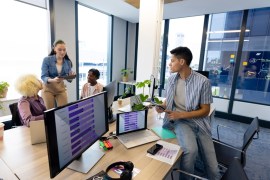
Why do people choose to go into an office, or a coworking space, when working remotely is equally viable? The answer, consistently, is other people. Not monitors. Not ergonomic chairs. Not free snacks. The Microsoft Work Trend Index found that 84% of employees would be motivated to come into the office by the promise of socializing with coworkers, and 85% by the chance to rebuild team bonds. Separately, 73% said they’d come in more often if they knew their direct team members would be there, and 74% said the same about work friends. The infrastructure is secondary. The people are the real attraction.
What “Social Anchor” Actually Means
A social anchor is a workspace that people choose to visit because of who is there, not what. It’s the office, floor, or coworking space where attendance is driven by human connection, by the pull of colleagues, collaborators, and even strangers, rather than by policy, assigned seating, or surveillance. When a workspace functions as a social anchor, people show up voluntarily. When it doesn’t, mandates fill seats but not conversations.
That distinction, between a building that houses work and a place that earns presence, is the central tension in every hybrid strategy being debated right now. And it’s a tension most return-to-office policies are getting wrong.
 The Three Reasons People Voluntarily Come In
If the social anchor is the concept, the mechanism underneath it has three distinct parts. Understanding them separately matters, because each one requires something different from the physical space, and most offices are only designed for one.
Coordination Pull: Scheduled Moments That Require Presence
This is the most intuitive reason to be in an office. A team sprint. An onboarding week. A quarterly planning session. These are moments where physical presence creates genuine value: whiteboards get filled faster than shared docs, side conversations resolve ambiguity in real time, and new hires absorb culture by proximity rather than by reading a handbook.
Most hybrid policies are built entirely around coordination pull. “Come in Tuesday through Thursday” is, implicitly, a bet that scheduling three days of overlap will generate enough collaborative value to justify the commute. Sometimes it does. But coordination pull alone cannot sustain attendance, because once the meeting ends, there’s no reason left to stay.
Ambient Belonging: Being Around People Without Performing
This is the reason that gets the least airtime and may matter most. Ambient belonging is the quiet comfort of working in a room with other people: hearing the low hum of conversation, a friendly nod on the way to get coffee, feeling like part of something without being required to contribute to it.
It’s the opposite of a Zoom call, where every second of silence feels like a failure. In a well-designed physical space, silence is fine. Presence is enough.
Gallup’s 2024 polling found that one in five employees reported feelings of loneliness, with fully remote workers reporting the highest levels. Ambient belonging is the antidote that can’t be replicated digitally. It doesn’t require programming or facilitation. It requires a space where people feel comfortable simply being, not performing productivity, not justifying their commute, just existing alongside others.
Serendipitous Collision: The Meeting That Cannot Be Booked
The third category is the one leadership teams love to invoke but rarely know how to enable. Serendipitous collision is the unplanned hallway exchange that turns into a project. The kitchen conversation where someone from a different team mentions a problem you’ve already solved. The new hire who overhears a debate and offers a perspective no one expected.
 These moments cannot be scheduled. They cannot appear on a calendar invite. And critically, they cannot happen in a space designed purely for task execution. They happen in transition zones: near coffee machines, in wide corridors with seating, in shared lobbies where paths cross. The Gensler Global Workplace Survey 2024, which covered more than 16,000 office workers across 15 countries, reinforced that workplace performance is not simply about presence but about the quality and design of the environment people inhabit.
Use this table as a quick audit against your current office or coworking setup.
| Reason for Coming In | What It Looks Like | What the Space Must Provide |
|---|---|---|
| Coordination Pull | Scheduled team sprints, onboarding sessions, cross-functional workshops | Reliable meeting rooms, collaborative zones, reliable tech for hybrid participants |
| Ambient Belonging | Working near colleagues without necessarily working with them; shared lunch, background noise | Open, lounge-style areas with low social pressure; quality coffee, kitchen, communal seating |
| Serendipitous Collision | The hallway conversation that turns into a project; spotting a colleague and catching up | Designed transition spaces: corridors with seating, shared entry areas, informal common areas near amenities |
Why Mandates Miss the Point
Consider a scenario. A 40-person marketing team at a mid-sized SaaS company institutes a three-day office week after pressure from the executive team. Six months in, Tuesday attendance is consistently high: 30 or more people, unprompted energy, people staying past 5 p.m. for no particular reason. But Monday and Thursday hover around 10. The HR lead initially reads this as policy failure. Two out of three mandated days aren’t working.
Turns out, Tuesdays are the days when the creative director, two senior leads, and the newest content hires all happen to come in. Not because the mandate says so, but because they’ve started arriving together by habit. Someone brings pastries. The afternoon gets loose and the space has quietly become a social anchor on Tuesdays. And it had nothing to do with the mandate.
This pattern repeats across industries, and it exposes the structural flaw in mandate-first thinking: requiring presence does not create the conditions that make presence valuable. After Amazon’s five-day RTO mandate took effect in January 2025, the company had to delay returns for thousands of employees across multiple cities and lease temporary space from WeWork because it didn’t have enough desks to accommodate its own workforce.
Many workspaces still assume people come in for obligation, productivity metrics, or supervision. That assumption produces policies optimized for headcounts and badge swipes. But headcounts don’t measure whether anyone talked to each other. Badge swipes don’t capture whether a new hire felt like they belonged. All the mandate does is fill the room.
What Designing for the Social Anchor Actually Requires
If the social anchor is emergent and person-driven, something that arises from behavior, , then the role of design is to create the conditions where it can take root. That’s a very different design brief than “maximize occupancy.”
From the Operator Side
Coworking operators who understand that their core product is not desks but the feeling of being among people hold a significant competitive advantage. In our interview with Mara Hauser of 25N Coworking, she noted that after the pandemic, approximately 50% of 25N members have another place to work. They choose to come in, and that’s a powerful signal that the space has to earn their presence every single day.
What does that look like operationally? It means community events that are opt-in, not compulsory. Zones calibrated for ambient presence: comfortable seating near windows, a kitchen that invites lingering, a reading nook that says “stay.” And staff trained to facilitate organic connection without forcing it. As Ary Krivopisk of The Yard put it in our interview: “Design sets the tone, but hospitality lives in consistency, the way coffee is stocked, how meeting rooms reset, how quickly someone responds when a member needs help.”
That operational consistency is what hospitality-driven workspace design that reduces friction and fosters connection looks like at the operator level. It’s a daily discipline. Operators interested in designing coworking spaces around community rather than capacity will find that the returns compound: members stay longer, refer others, and, critically, show up more often, which makes the space more magnetic for everyone else.
From the Team Side
For HR and workplace strategy leads managing hybrid teams, the diagnostic is straightforward. Apply this test: if your team would still come in even without assigned desks, your office is functioning as a social anchor. If they wouldn’t, it’s just a building.
Designing for the social anchor from the team side means three things.
- First, identify your coordination pull days and protect them, but don’t mandate the rest. Let ambient belonging and serendipitous collision emerge around natural clusters.
- Second, invest in the in-between spaces: the coffee setup, the communal lunch table, the hallway wide enough for two people to stop and talk without blocking traffic.
- Third, stop measuring attendance and start measuring gravity: which people, which days, and which rituals are drawing others in.
A fixed lease optimized for 100% daily attendance makes no behavioral sense for a team that comes in for social reasons two or three days a week. Flex memberships that let teams book what they actually use on the days they actually show up are structurally better aligned with how people now choose to work. The workspace model should follow the behavior, not the other way around.
 The Coworking Advantage
The coworking sector’s growth is itself evidence that the social anchor model is not a niche preference. It’s a structural shift. That growth is driven by people who have offices and are choosing something different. As Mara Hauser of 25N Coworking noted in our interview, approximately 50% of their members have another place to work — they choose to come in, which signals that the space has to earn their presence every single day.
The advantage coworking holds in this landscape is specific: these spaces were designed, from the beginning, for people who don’t have to be there. Every design choice, the communal kitchen, the event calendar, the on-site community manager, exists because the space has to earn attendance daily. Traditional offices are now trying to retrofit that same magnetism, often unsuccessfully, because the underlying assumption was always captive occupancy.
For organizations exploring return-to-office strategies that actually support connection, coworking offers something beyond square footage: a pre-built social infrastructure that most corporate offices would need years and significant capital to replicate.
Quick Audit: Is Your Workspace a Social Anchor?
- Would your team choose to come in on a day with no scheduled meetings?
- Do people linger after their work is done, or leave the moment they’re finished?
- Are there informal zones where unplanned conversations happen regularly?
- Do new team members say they chose to come in, rather than felt obligated?
- Is there at least one communal ritual (shared coffee, a weekly lunch, a recurring informal event)?
If you answered yes to three or more, your space is functioning as a social anchor. If not, your space may be providing desks without providing reasons.
 Bottom Line
People don’t commute for furniture. They commute for other people: for the team lead who makes Tuesdays feel productive, for the ambient hum of a space that feels alive, for the conversation in the hallway that couldn’t have happened on Slack. The organizations and operators who understand this are not building offices or coworking spaces around desks per square foot. They’re building around social gravity per visit. The question is no longer “are people here?” It’s “does being here do something for them?” If your people would come in without being told to, you’ve built a social anchor. If they wouldn’t, no mandate will fix what the space itself isn’t providing. Design for the pull, not the push, and the attendance will follow the people.
If you’re rethinking your team’s workspace strategy and want to see what’s available near the people who matter most, start exploring flexible workspaces on CoworkingCafe.
FAQ
What does “social anchor” mean in a workplace context?
A social anchor is a workspace, whether a traditional office or a coworking space, that people choose to visit primarily because of the people there, and not for the physical infrastructure. It functions as a gravitational point where attendance is driven by relationships, team habits, and the comfort of being around others.
Why do people go to the office when they can work remotely?
The primary driver is social connection. The Microsoft Work Trend Index found that 84% of employees would be motivated to come in by the promise of socializing with coworkers, and 73% would come in more often if their direct team members were there. People are drawn to coordination with their teams, the ambient comfort of shared presence, and the possibility of spontaneous, valuable conversations.
How is a social anchor different from a return-to-office mandate?
A mandate compels attendance through policy. A social anchor earns it through experience. Mandates fill seats but do not guarantee interaction, belonging, or collaboration. A social anchor emerges when the people, rituals, and spatial design of a workspace make presence feel worthwhile, something that cannot be achieved through scheduling alone.
How can I tell if my office is functioning as a social anchor?
Ask whether your team would come in on a day with no meetings scheduled. Observe whether people linger after their tasks are done or leave immediately. Check whether unplanned conversations happen regularly in communal areas. If attendance is driven by who else is there rather than what’s required, your space is functioning as a social anchor.
What role does coworking play in the social anchor model?
Coworking spaces were designed from the outset for people who have a choice about where to work. Their community programming, communal layouts, and hospitality-oriented operations are built to earn daily attendance, the exact capability that social anchoring requires. As a result, coworking environments often outperform traditional offices at generating ambient belonging and serendipitous connection.
Can you design a workspace to become a social anchor?
You can design the conditions for it, but you cannot mandate the outcome. That means investing in transition spaces where unplanned interactions occur, communal areas with low social pressure, opt-in community rituals, and operational consistency in hospitality details. The social anchor itself emerges from people’s behavior within those conditions.