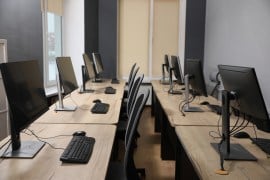
Let’s imagine a 28-person marketing agency in Austin renewed a 5,200-square-foot lease because their broker told them the standard was 175 square feet per person. They were paying for 28 desks. On any given day, 16 people showed up. They ran a badge-data audit, profiled their team by work style, and moved to a 2,400-square-foot anchor office plus 12 coworking memberships. Their monthly real estate cost dropped 38%. The desks they kept were actually full.
That 150-to-175-square-foot benchmark (the one you’ll find cited by JLL, CBRE, and every workplace planning guide) isn’t wrong. It’s just answering a question most companies aren’t actually asking anymore. That number was designed for a world where everyone came in, sat in an assigned seat, and stayed until five, which is no longer the default. A fixed per-person ratio applied to a hybrid attendance pattern means you’re either overpaying for empty desks or short on space the two days a week people actually show up.
So the question worth asking is how much space each work style needs, and how many days a week it actually needs a seat.
TL;DR: Stop sizing your office by headcount. Pull 90 days of badge data, profile your team by how they actually work (deep focus, collaboration, client-facing, or roaming), and size the space for attendance patterns. For most hybrid teams, the math points to a smaller anchor office plus flex memberships, which comes at a fraction of the traditional lease cost.
How Coworking Changes the Denominator
Traditional space planning uses a straightforward formula: headcount × square feet per person = total space needed. Then you add 10–20% for growth. The result almost always overshoots, because it assumes everyone shows up at the same time, which isn’t the case most times anymore.
Coworking flips this equation. Instead of buying space for your busiest peak, you buy access for your average day. A 30-person hybrid company averaging 18 in-office on a typical day needs 18 to 20 memberships at $220 a month, with day passes at $30 covering the peak days. Monthly outlay drops from north of $14,000 on a traditional lease to under $5,000, and seat count flexes within a billing cycle instead of a contract negotiation.
The savings hold across markets. CoworkingCafe’s cost comparison study found coworking more affordable than a traditional lease in 97% of the 102 U.S. cities analyzed, with savings reaching up to $103,000 a year for a 10-person team in markets like Sunnyvale, CA.
And the supply is there too. The U.S. coworking market now spans over 9,100 locations and 163.9 million square feet, with the average site running just under 18,000 sq. ft. In dense urban markets like Manhattan and Chicago, individual locations run 25,000–40,000 sq. ft. — large enough to host entire mid-sized company teams under one roof.
Four Work Styles, Four Space Profiles
Most office work falls into four patterns, each with different space needs, and most teams are a mix of all four.
The Deep-Focus Worker
 Developers, analysts, writers, accountants — anyone whose best output comes from uninterrupted concentration.
Space need per person: 80–120 sq. ft. in a high-density focused layout (individual pods, library-style quiet zones), or 150–200 sq. ft. in a private or semi-private office. The range depends on whether acoustic privacy comes from architecture (walls, doors) or design (sound masking, high-backed booths).
Seat frequency: 2–3 days per week is typical. Many deep-focus workers do their best work from home and come in selectively.
Practical test: Walk through your office at 2 p.m. on a Tuesday and count noise-canceling headphones. That’s your deep-focus cohort, and they’re telling you the layout doesn’t match the work.
The Collaborator
Project managers, creative leads, product teams — anyone whose day runs on whiteboard sessions, standups, and real-time problem-solving.
Space need per person: 100–150 sq. ft., but with a critical reallocation. Roughly 40% should be individual workspace and 60% should be shared — meeting rooms, huddle spaces, project rooms with writable walls. The standard layout flips this ratio (mostly desks, a few conference rooms) and then can’t figure out why nobody can find a room.
Seat frequency: 3–4 days per week. These roles get the most from in-person time, but the value comes from the right kind of space, not just a desk.
Practical test: Pull your meeting room booking data. If rooms are at 90%+ utilization Tuesday through Thursday but open desks are half empty, you have a collaborator-heavy team in a deep-focus-designed office.
The Client-Facing Professional
Lawyers, consultants, financial advisors, sales leads who run in-person presentations — anyone bringing external people into the workspace regularly.
Space need per person: 150–250 sq. ft., on the higher end. Private offices, presentable conference rooms, and a reception area that doesn’t look like a startup garage all factor in.
Seat frequency: 4–5 days per week, though the trendline is shifting. If half your client interactions now happen on video, you may be over-allocating private space for roles that functionally need less of it than they did in 2019.
Practical test: Count your private offices. Then count how many hours per week each one is actually occupied by the person assigned to it. Below 50% means you’re paying for a $456-per-month serviced equivalent that’s empty half the workday.
A note on when coworking doesn’t fit: a 10-attorney firm meeting clients on-site four days a week needs a traditional office or serviced suite with a presentable reception. Coworking common areas and hot desks won’t solve that. Knowing where the flex model breaks down makes the recommendation more useful where it works.
The Roamer
Hybrid employees, field reps, part-time remote workers, executives splitting time between offices — anyone whose attendance is irregular by design.
Space need per person: 50–80 sq. ft. in a shared or hot-desk model. The lowest per-person allocation, but it only works if the shared space is well-managed. A hot desk that’s always claimed by the same three people isn’t shared. It’s unassigned resentment.
Seat frequency: 1–3 days per week. The math here favors seat-sharing ratios. JLL data shows organizations moving from 1.1 people per seat toward 1.3, which is about 30% more employees than seats, with shared desks absorbing the variance.
Practical test: Pull a month of badge data or Wi-Fi logs. Anyone showing up fewer than three days a week doesn’t need a permanent desk. They need reliable access to a good one.
What This Actually Costs: Space by Workspace Model
Here’s how the numbers stack up across the four most common workspace models, using current data:
| Dimension | Traditional Lease | Serviced Office | Coworking Membership | Day Pass (On-Demand) |
| Typical sq. ft. per person | 150–250 | 100–150 (included in fee) | 50–100 (shared) | Varies (shared) |
| National avg. cost | $32.79/sq. ft./year (full-service equivalent, Yardi Matrix, Feb 2026) | ~$456/desk/month | $220/month (national median, Q1 2026) | $30/day (national median) |
| Cost for 10-person team (monthly) | ~$4,100–$6,800+ (depending on density) | ~$4,560 | $2,200 | Varies by usage |
| Commitment | 3–10 year lease | 6–24 months typical | Month-to-month available | None |
| Growth buffer needed | 10–20% extra space | Minimal | None | None |
| You’re sizing for… | Peak capacity + future growth | Current headcount | Average attendance | Individual days |
The comparison changes depending on your team’s work style mix. A team of 10 deep-focus workers who come in four days a week needs something close to the serviced or traditional office column. A team of 10 roamers who each come in twice a week needs five desks, not 10, and coworking or on-demand space can deliver those five desks at a fraction of the traditional cost.
The Five-Step Space Audit
 Benchmarks get you in the ballpark, but your actual badge data tells you what you need. Here’s how to find your real number.
Step 1: Pull 90 days of attendance data. Badge swipes, Wi-Fi logs, desk booking records — whatever captures who showed up and when. Ninety days smooths out holidays, sick weeks, and one-off events.
Step 2: Calculate your three key numbers. Average daily attendance (your sizing baseline), peak daily attendance (your capacity ceiling), and the gap between them (your overprovisioning risk). If your peak is more than 40% above your average, you’re probably paying for space you don’t need most days.
Step 3: Profile your team by work style. Use the four categories above. You don’t need precision, a rough percentage is enough. If 40% of your team is deep-focus, 30% is collaborative, 10% is client-facing, and 20% is roamers, your blended space need is very different from a team that’s 60% client-facing.
Step 4: Run the math by work style, not by headcount. Multiply each cohort’s size by their required square footage and their attendance frequency. A group of eight roamers who each come in twice a week needs four desks and at 50–80 sq. ft. per desk, that’s 200–320 sq. ft., not 1,200.
Step 5: Compare your result to what you’re paying for today. Most companies discover a 20–40% gap between what they need and what they have. That gap is either an opportunity to downsize and save, reallocate toward better space (more meeting rooms, fewer dead desks), or shift part of the footprint to flex workspace that matches actual demand.
A quick sense-check: divide your current all-in office cost by the number of employees actually present on an average day. If that figure runs significantly above the $220 national median for a coworking membership, model the hybrid alternative (anchor office plus flex memberships) in detail.
The Bottom Line
The 150-to-175 benchmark answered a question your team probably no longer asks. The question now is what your attendance pattern looks like and which mix of space matches it — and that’s a number only your badge data can give you.
Start with the five-step audit. Compare your result against the four workspace models. Then search CoworkingCafe for flexible workspace across your city — filter by location, workspace type, amenities, and price to find spaces that match how your team actually works.