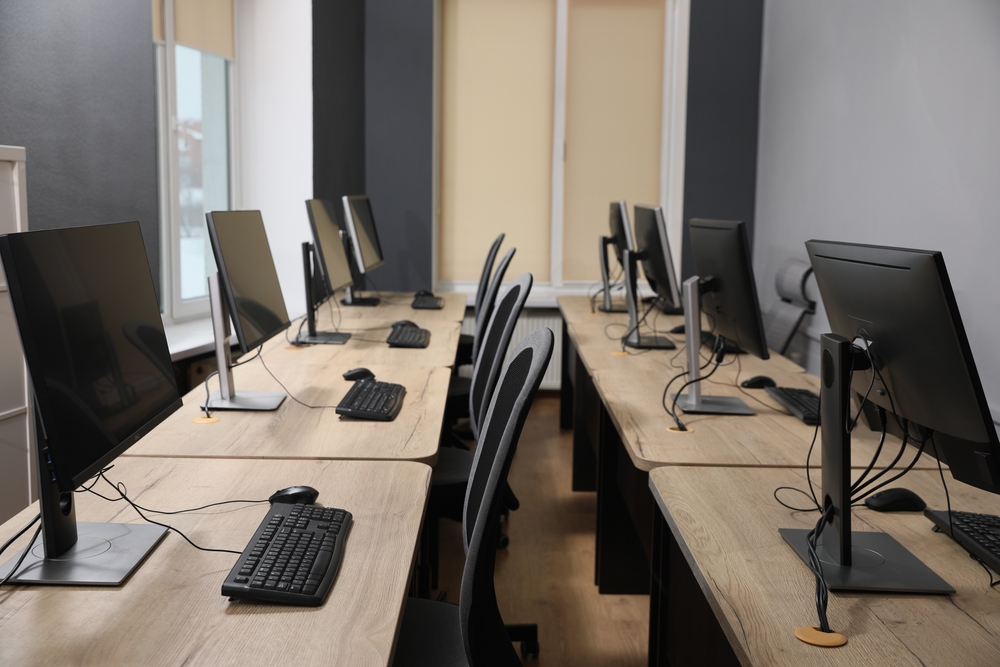
Your office has 60 desks. On Tuesday, 78 people showed up. On Thursday, 23. Both numbers are wrong, but only one of them is loud — Tuesday is the day people complain. Thursday is the day your CFO scrolls through badge data and asks why you’re paying for empty real estate.
Hot-desking is the standard answer to that gap. Provision fewer seats than employees, let people share, save the difference. The hard part isn’t the model — it’s the math. How many fewer seats? One per two people? One per three? One per five? Pick wrong on the low side and Tuesdays become a hostage situation. Pick wrong on the high side and you’re paying flex-space rates for desks nobody touches.
The answer isn’t a single number. It’s a set of numbers — different ones for different teams — and the levers that move them up or down. This is the math.
Why One Ratio for the Whole Company Is the Wrong Starting Point
Most hot-desking guidance starts with a company-wide ratio. 1:1.5. 1:2. 1:3. The number gets pulled from a vendor’s case study or a peer company’s intranet, applied across the org, and then quietly broken within a quarter — because engineering doesn’t behave like sales, and sales doesn’t behave like customer success.
A 1:2 ratio looks reasonable on paper. Apply it to a 100-person company and you provision 50 seats. But if 30 of those 100 are customer success reps who are in the office four days a week running calls, and 25 are field sales reps who are in maybe three days a month, you’ve simultaneously under-provisioned the support team and over-provisioned everyone else. The average is fine. The reality is broken.
The right starting move is to size by team type, then aggregate. A blended ratio falls out of the math at the end — but it’s an output, not an input.
 The Five Team Types and Their Ratio Ranges
These ranges assume hybrid policies with anchor days and reasonable team distribution. They’re starting points. The calibration levers in the next section move the numbers up or down.
Engineering and R&D: 1 seat per 2.5–3 employees
Engineers come in for collaboration, not for solo focus work — and most engineering orgs have settled into a rhythm where one or two days a week is the in-office norm. Sprint planning, design reviews, pair programming, and the occasional whiteboard session pull people in. The rest of the time, they want their home setup, their second monitor, and their door.
The result is a team with relatively predictable in-office days (often Tuesday and Wednesday, sometimes Thursday) and very low presence the rest of the week. A 1:3 ratio works for engineering teams that have settled into a true two-day cadence. Push toward 1:2.5 if your team runs heavier on collaboration weeks — early-stage product teams, teams in pre-launch crunch, or any team that’s still working out its rituals.
The tell that you’ve sized wrong: engineers stop coming in on the days you expected them, because they couldn’t find a seat the last time they tried.
Sales and business development: 1 seat per 4–6 employees
Sales is the team that breaks every assumption about office attendance. Field reps live in cars, planes, and customer offices. SDRs and BDRs may be more deskbound but cluster their in-office days around team kickoffs, training, and quarter-end pushes. The “average attendance” number for a sales org tells you almost nothing — what matters is the shape of the curve.
A 1:5 ratio works for most outbound-heavy sales orgs with a mix of field and inside reps. Push to 1:4 if your sales team runs weekly all-hands or training in person — those days will spike hard. Stretch to 1:6 if your reps are nearly all field, and the office is mostly a once-a-month touchpoint.
One check worth doing: pull badge data for the first and last weeks of the quarter and compare them to a random week in the middle. If the gap is more than 3x, your sizing has to account for the spike, not the average. Otherwise quarter-end becomes the chaos that your CFO hears about.
Customer success and support: 1 seat per 1.5–2 employees
Support teams are the inverse of sales. They run calls and ticket queues from a desk, often on a roughly fixed schedule, and many of them prefer the office because the noise floor at home is worse than the noise floor in a call-friendly area of the workspace. Some companies still run support fully on-site for compliance or quality reasons. Others have shifted to mostly remote with a steady in-office contingent.
A 1:2 ratio is the realistic floor for a hybrid support org. Tighten to 1:1.5 — or even 1:1 — if your support model leans on consistent presence, has compliance requirements that anchor people to a controlled environment, or relies on senior reps coaching new hires in real time. The team that runs at 1:3 or 1:4 is almost always a team where leadership doesn’t actually know what support is doing day-to-day.
Creative and design: 1 seat per 2–3 employees
Creative teams are bimodal. They cluster in person for project kickoffs, critique sessions, and any work that benefits from sketching on a wall together — and then they disappear into deep focus work that’s almost universally easier from home. Designers in particular tend to dislike open floor plans for production work and love them for ideation.
A 1:2.5 ratio is a safe default. Move to 1:2 if your creative org has heavy in-person rituals (weekly crits, frequent client presentations, brand work that requires shared physical artifacts). Stretch to 1:3 if your creative team is mostly individual contributors working remotely with occasional team-day clustering.
The honest tell here: if the office has a “creative zone” with whiteboards and pinboards that hasn’t been used in a month, the team has voted with their feet.
Executive and operations leadership: 1 seat per 1–1.5 employees
Leadership ratios are different because the function is different. Executives and senior ops leaders aren’t really hot-desking — they’re using the office as a control tower. They take confidential calls, hold one-on-ones, host visitors, and need a consistent place to land. A 1:1 ratio (effectively, dedicated seating) is normal for the C-suite and senior VPs. A 1:1.5 ratio works for the next layer down — directors and senior managers — who are in often enough that hot-desking feels disruptive but flexible enough that some sharing is reasonable.
Trying to hot-desk your CFO at 1:3 to “save real estate” is the kind of decision that gets quietly reversed within a month, after the CFO realizes their files, their second monitor, and their privacy are all gone.
Quick reference: ratio ranges by team type
| Team Type | Ratio Range | Tightening Trigger |
| Engineering / R&D | 1 : 2.5–3 | Pre-launch crunch; early-stage product teams |
| Sales / BD | 1 : 4–6 | Weekly in-person training or all-hands |
| Customer Success / Support | 1 : 1.5–2 | Compliance-anchored work; coaching-heavy teams |
| Creative / Design | 1 : 2–3 | Heavy critique cadence; client-facing brand work |
| Executive / Ops Leadership | 1 : 1–1.5 | Senior-most layer; confidential workflows |
The Three Levers That Shift Any Ratio
The ranges above assume a set of conditions. Change the conditions and the numbers move. There are three levers that matter most.
Anchor days. The biggest single variable. If your company runs anchor days — say, “Tuesdays and Thursdays for everyone” — you’ve concentrated demand. The ratio has to be tighter, because the peak day is now the only day that matters. Stanford economist Nicholas Bloom’s 2024 randomized controlled trial in Nature studied 1,612 employees on a hybrid schedule and found that anchor-day hybrid (everyone in on the same days) produced retention and productivity outcomes equivalent to fully in-office work — but only when the office could actually accommodate the spike. Anchor days without enough seats produce the worst of both worlds: the cost of the office and the friction of remote.
If you run anchor days, tighten every ratio above by roughly 20%. A 1:3 engineering ratio becomes 1:2.5. A 1:5 sales ratio becomes 1:4.
Team distribution. Are people choosing their in-office days, or is the company assigning them? Self-selected days flatten the curve — people naturally avoid the chaos of the busy day and pick the easier ones. Assigned days concentrate it. The Gensler Workplace Survey has tracked this distribution effect across hybrid programs and found that companies with self-selected hybrid policies see meaningfully more uniform daily attendance than those with assigned anchor days. Loosen the ratio when distribution is self-selected. Tighten it when it’s enforced.
Growth velocity. A team that’s growing 30% a year will outgrow whatever ratio you set within a quarter or two. The best move isn’t to over-provision now — that just shifts the cost forward. The better move is to set the ratio for current headcount and write the growth case into the lease or membership agreement. Flex space exists precisely to absorb this kind of variability; if you’ve signed a five-year lease for a fixed seat count, you’ve defeated the point.
 From Ratios to Real Estate
Once you have ratios by team type, the rest is arithmetic. A 120-person company with the following composition:
- 50 engineers (1:3) → 17 seats
- 30 sales (1:5) → 6 seats
- 20 support (1:2) → 10 seats
- 12 creative (1:2.5) → 5 seats
- 8 leadership (1:1.25) → 7 seats
…lands at 45 seats for 120 people, or a blended ratio of roughly 1:2.7. That number is the input to your space search — not the output.
This is where flex inventory becomes the practical answer. According to CoworkingCafe’s Q1 2026 U.S. industry data, the national average flex location is just under 18,000 square feet, which translates to roughly 80–120 seats depending on layout density and amenity mix. A 45-seat requirement fits comfortably inside a single flex location in any of the 120 markets CoworkingCafe tracks — and in most of them, you have several dozen options to compare. The Q1 2026 data shows 9,136 U.S. coworking locations operated by 4,431 unique providers, which means even after you filter by location, amenity profile, and price band, you’re rarely looking at a thin shortlist.
Pricing scales the decision. A 45-seat membership in Manhattan, where the median membership runs $339 per person per month, is materially different from the same headcount in Chicago at $199, or in Salt Lake City at $169. The ratio framework doesn’t change — but the cost of getting it wrong on either side does.
Search CoworkingCafe for: dedicated desk and hot-desk options in your target metros, filtered by total seat count and meeting room availability. The platform’s filters surface what’s actually within reach for the headcount you’re sizing — without cold-calling brokers in five cities.
Common Mistakes That Break the Math
A few patterns show up repeatedly when ratios fail in practice.
Sizing to the average instead of the peak. The average attendance day is irrelevant. Tuesday is the day that matters, because Tuesday is the day people will tell you the office “doesn’t work.” If your average attendance is 40% but your Tuesday attendance is 75%, you have to provision for 75%. The other days will absorb themselves.
Treating attendance data as stable. Hybrid attendance shifts. New hires anchor differently than tenured employees. Post-holiday weeks look different from mid-quarter weeks. Reps cluster around quarter-end. A ratio set in March and never revisited will be wrong by September.
Ignoring the role of meeting rooms. Hot-desk seats are only one piece. If your team comes in for collaboration and your meeting rooms are fully booked by 10 a.m., the desk count is the wrong problem to solve. CoworkingCafe’s Meeting-Room Math guide covers the companion calculation — the two have to be sized together, not in sequence.
Forgetting the leadership exception. A blended company-wide ratio of 1:2.7 looks elegant. It also implies that the CEO and the SDR are sharing seat strategy. They aren’t. Build the ratio team by team, accept that some teams will run hot and others will run loose, and stop optimizing for a single number that doesn’t exist in practice.
Skipping the diagnostic test. Before signing for any seat count, run the test that vendors won’t tell you to run: pull six weeks of consecutive badge data — not the report your facilities vendor gave you, the raw data — and graph it by day of week. The shape of that curve is your ratio. If you don’t have badge data, sit at the front desk for three Tuesdays in a row and count people. Either method beats a benchmark report.
FAQ
What if our team policy is “fully flexible — come in whenever”?
Fully flexible policies tend to produce attendance that looks like a self-selected hybrid program, just with more variance. Use the ratios above as starting points but loosen them by 10–15% on the assumption that demand will spread out. Re-check after 90 days; flexible policies often drift toward de facto anchor days as teams self-organize around recurring meetings.
Should we count meeting rooms in the seat ratio?
No. Meeting rooms serve a different function — collaboration, calls, focused group work — and should be sized separately based on meeting volume and team patterns. A team that hot-desks at 1:3 and has zero bookable rooms will still be miserable.
How do we handle teams that need confidential workspace — legal, HR, finance?
Treat them as a leadership-tier exception. Compliance-sensitive functions need either dedicated seating or access to private rooms with reliable acoustics and screen privacy. The hot-desk ratio for these teams is effectively 1:1, even if everything else in the company runs lighter. CoworkingCafe’s guide to compliance-ready workspace covers what to look for in private suites and dedicated networks for these teams.
What ratio should we start with if we have no data at all?
Start at 1:2 for the entire company, sign a flex membership rather than a long lease, and re-evaluate at 90 days. The cost of being wrong with flex is six weeks of paying for too many seats. The cost of being wrong with a five-year lease is five years.
The Number You’re Sizing For
The right seat-to-employee ratio for your company isn’t on a benchmark report. It’s in the gap between how often your engineers come in and how often your support team does, between the Tuesday spike and the Thursday lull, between the office you signed up for and the office your people actually use.
Hot-desking works when the math respects those differences. A blended 1:2.7 ratio that comes from real team-level numbers will outperform a tidy company-wide 1:2 every time — because the tidy number is fictional, and Tuesday isn’t.
Compare providers on CoworkingCafe. Filter by location, total seat count, meeting room availability, and amenity mix to match what your ratio framework actually requires.