
Across science, engineering and technology roles, women’s presence has grown steadily over time. While the same goes for remuneration, progress has been uneven and far from universal, and neither representation nor pay parity have fully closed the gap a quarter of the way into the 21st century.
Today, women account for roughly a quarter of the UK’s STEM workforce. In professional STEM roles, female median earnings stand at around £46,000 a year, which is equivalent to roughly 89p for every pound earned by men. This is broadly in line with the overall UK gender pay gap of 6.9% reported in April 2025 by the Office for National Statistics.
No doubt, representation and wage gap make strong headlines. That said, speaking about them in broad terms and national figures not only fails to tell the full story, but also conceals meaningful local differences. Specifically, industry presence, labour demand, and purchasing power vary sharply across UK cities, so location shapes short-term opportunity and long-term financial stability just as much as the role itself.
To mark International Women’s Day, we analysed 95 of the country’s largest cities and towns across 10 key indicators to identify where women in the STEM workforce have the strongest overall career prospects.
Table of contents
1. Cambridge
2. Edinburgh
3. Stevenage
4. Oxford
5. Newcastle upon Tyne
6. Glasgow
7. Aberdeen
8. Manchester
9. Warrington
10. Liverpool
Why London Isn’t on the List
Methodology
Top cities reveal success comes in different forms
Three distinct models of opportunity emerge across the best places in the UK for women pursuing STEM careers:
- Elite innovation hubs: High opportunity with costs to match
Cambridge and Oxford lead in job density and female representation, but housing affordability pressure bites hard into the purchasing power of STEM wages in these cities.
- Steady performers: Major cities that don’t force a trade-off
Edinburgh, Manchester, and Glasgow may not match the STEM buzz of elite hubs, but their strong female representation and moderate cost burden lay solid foundations for balance.
- Where earnings stretch further: Purchasing power at density’s expense
Aberdeen, Warrington, Liverpool and Newcastle demonstrate lower STEM concentration, but moderate housing costs keep earnings competitive.
1. Cambridge
There is no other city in the UK that matches Cambridge’s concentration of STEM talent. Here, nearly one in five jobs is in STEM, and more than one-third of these are occupied by women — the second-highest level of female STEM participation of any city examined. Plus, the number of monthly hiring opportunities also tops the index, making it the most active STEM job market in the country for women looking to enter or advance.
The challenge, however, is well known to anyone who has ever searched for a flat within cycling distance of the Biomedical Campus: Cambridge scored just 10.6 out of 100 on affordability with average house prices approaching £484,000 and rent consuming nearly half of the median earnings. Therefore, it’s safe to say that the city will accelerate a STEM career faster than almost anywhere else in the country, but it’s also a place where the cost of living demands serious financial planning to make it work long-term.
2. Edinburgh
Edinburgh is the only city in the top 10 without an obvious trade-off. Whereas Cambridge and Oxford trade affordability for opportunity and Aberdeen does the opposite, Edinburgh balances the books across every metric analysed.
The most significant is gender pay equity: women in STEM earn 99.2p on the pound, a gender pay gap matched only by other Scottish STEM locations and a world away from London’s 82.4p. Furthermore, this parity comes in a labour market context where women hold the third-highest share of STEM roles at 31.7%, and housing costs are grounded enough to let those earnings breathe. So, for women building long-term STEM careers, Edinburgh offers a genuinely rare combination: strong opportunity, near-equal pay and manageable cost of living.
3. Stevenage
The town that produced Britain’s first jet fighter posts the highest earnings score in the top 10. To be precise, annual pay for women professionals in STEM roles reaches £53,505 (above even London), reflecting a deep aerospace and defence heritage where major employers have rewarded technical skills at premium levels for decades.
But, unlike London, Stevenage doesn’t claw those earnings back at the front door. Instead, average rents of £1,371 and house prices around £312,000 keep the town broadly in line with national affordability levels, a far cry from the premium demanded by the southern innovation hubs ranked on either side of it. Clearly, for women in STEM optimising take-home purchasing power, Stevenage is hiding in plain sight.
4. Oxford
Oxford boasts the highest female share of STEM employment of any city analysed. At 35.5%, it leads the country by a clear margin, 10 percentage points above the national average and ahead of even Cambridge. Additionally, in a field where the balance of gender representation has been so stubbornly uneven, this alone is cause for celebration. Now, the life sciences community centred around the university and the region’s leading hospitals has created a STEM environment in which women are not only represented, but also prominent.
That said, the trouble is that representation and affordability don’t always travel together. In fact, Oxford’s affordability score of 5.6 is the lowest of any city in the top 10 with its house prices at Cambridge’s level and rent taking up more than half of median salaries. As such, women pursuing research and engineering careers will find fewer barriers to entry here than almost anywhere else in the UK, but maintaining a foothold in this environment means living with some of the highest costs outside of London.
5. Newcastle upon Tyne
Notably, Newcastle is the only city in the study where women in STEM-associate roles earn more than men. In this case, a female-to-male pay ratio of 100.9% is not a rounding quirk. Rather, it reflects a local economy where technical roles in sub-sea engineering, digital technology, and health sciences have drawn women into positions that command strong and genuinely equitable pay.
Of course, that distinction lands differently when housing costs don’t consume the gains. Here, average house prices sit just below £201,000 and rents absorb 37.3% of median earnings — both well below national figures. The reality is that, even though the city missed the podium (mostly because of a lower overall industry representation in the local job market), a woman on a STEM salary in Newcastle can save faster, buy sooner and plan further ahead than she could in any of the four cities ranked above it.
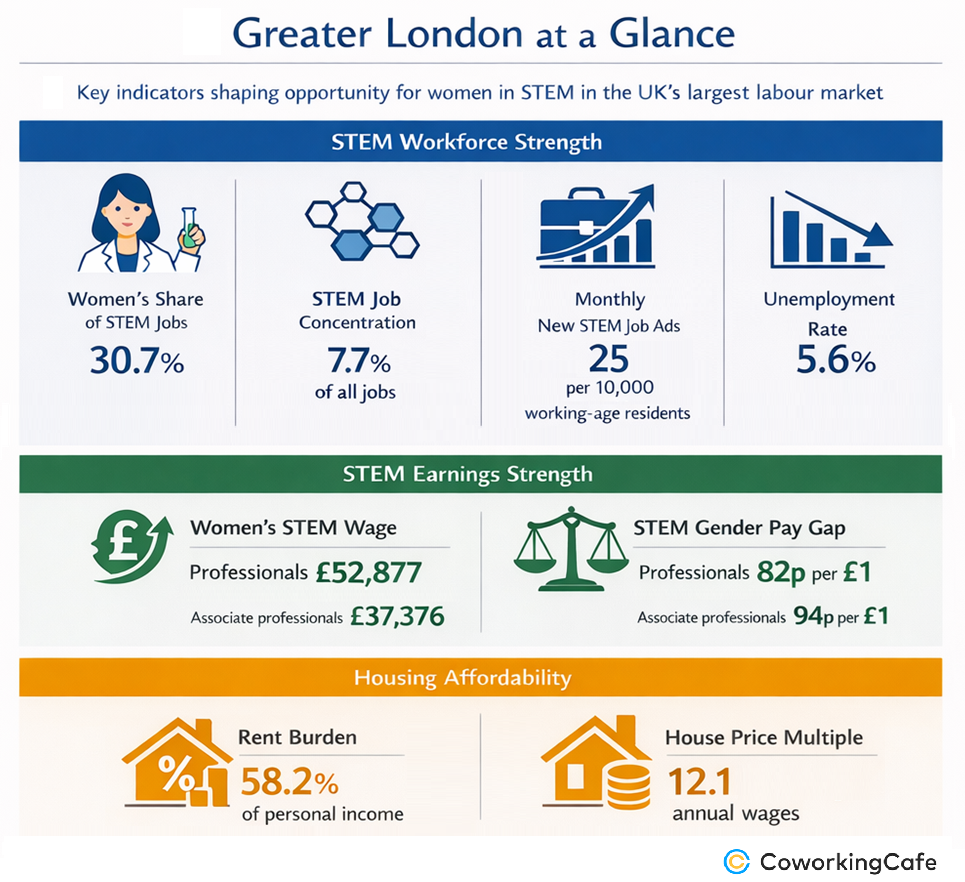
Why London Isn’t on the ListLondon dominates the UK’s STEM economy in absolute terms. For example, it generates more STEM job adverts than any other region; offers the highest raw salaries for women in STEM professional roles at £52,877 annually; and claims 30.7% of STEM positions for female specialists, which is well above the national average of 25.3%. But, the capital’s headline figures unravel under the weight of its own costs. Namely, rent absorbs 58.2% of median full-time earnings (the highest burden of any major city analysed), and average house prices of £560,269 produce a price-to-income multiple of 12.1 for nearly double the national figure of 6.9. Essentially, a woman earning a STEM professional salary in London takes home more in gross terms than her counterparts in all but three cities in this index, yet she keeps less of it after housing compared to women in most of the top 10 cities.
Even so, London remains a powerful launchpad for STEM careers, particularly in financial technology, AI and biotech. But, when opportunity, pay equity and affordability are measured together, as this index does, the capital’s strengths are consistently offset by the price of simply being there. |
6. Glasgow
Glasgow won’t outbid Edinburgh on polish or Cambridge on prestige, but it nevertheless provides something that those cities charge a premium for: the chance for women to build a STEM career in a culturally rich major city without spending years waiting for the finances to catch up.
Accordingly, the city pairs Scotland’s near-perfect gender pay equity with some of the lowest housing costs in the top 10. More precisely, women earn 99.2p for every pound that men earn in STEM professional roles, while average house prices of £186,834 represent just 4.9 annual wages, or less than half of the sum and effort that Cambridge or Oxford demands. Thus, for a woman earning the local STEM professional salary, the path from renting to owning is measurably shorter here than it is in almost any other leading city in the index.
7. Aberdeen
Aberdeen is the most budget-friendly of any city included in the analysis, and not just by a whisker, either. Here, the rent-to-income ratio is 25.4% and the average house price is 3.5 times the median annual salary, which translates into a cost of living for women in STEM occupations that’s just about half the national average. Consequently, a worker with a median salary in Aberdeen would pay less for a year’s rent than someone in Cambridge pays in seven months.
That financial headroom comes in the context of Scotland’s characteristic gender pay equity and a STEM employment share of 10.4% that’s sustained by the city’s energy engineering heritage. But, the constraint is scale: hiring volume is the lowest of any top-10 city, so although Aberdeen rewards women who are already established in STEM roles, options for those pursuing their first break are limited compared to other top-ranking hubs.
8. Manchester
Manchester’s case is ultimately about momentum and optionality as it’s a city scaled for progression, where the breadth of STEM employers (especially in the city’s expanding tech and digital sector) provides genuine career mobility without requiring a relocation every time opportunities shift. Accordingly, the city generates the second-highest STEM labour demand among the top 10 cities, and for women entering (or reentering) the workforce, that volume of opportunity matters as much as any salary figure.
Meanwhile, women hold 28.9% of STEM roles (which is above the national average), and the gender pay gap for associate professionals is among the narrowest measured in the UK. At the same time, affordability is neither a headline strength nor a serious concern, hovering near national averages on both rent and house prices.
9. Warrington
For women who prioritise financial security and stability, Warrington offers something that flashier locations often promise and rarely deliver: earnings that actually translate into long-term resilience. That’s because, at 25.3%, the city delivers the lowest rent-to-income ratio of any city in the top 10, coupled with STEM associate professional wages exceeding £37,000, the second-highest figure recorded in the index.
Plus, the unemployment rate is just 3.1% (the second-lowest in the top 10), but Warrington’s STEM job market is smaller in scale than the major cities and it has fewer active openings relative to the working-age population. But, for women who prioritise financial security and stability over breadth of choice, that trade-off may be well worth it.
10. Liverpool
Last, but not least, Liverpool closes out the top 10 as the city where a STEM salary stretches furthest in a genuinely major metropolitan setting. In this area, house prices average £177,785 and monthly rents sit at £856 to produce affordability figures that rival Aberdeen’s, but within a city that offers the cultural and social infrastructure that smaller towns simply cannot match.
In Liverpool, women hold 28.5% of STEM roles (above the national average), and the North West’s consistent gender pay equity means that female associate professionals take home 96.1p for every pound earned by men in similar roles. However, STEM depth is a limitation. At 5.7% of total employment, the city has the smallest STEM footprint of any top-10 entry. Fortunately, for women whose specialisation aligns with the local market, Liverpool makes a straightforward proposition as a major city where a STEM career provides not just comfort, but also the financial margin to plan ahead.
Methodology
- The study analyses the largest UK cities and towns by Built-Up Area (BUA) population, and the data was analysed at Local Authority Districts (LAD) level or equivalent. In LADs with several cities, only the most populous was kept.
- Only cities with full data available for all indicators were included in the final results (95 cities and towns).
1. STEM Workforce Strength (50% of total index)
Women’s Share of STEM Jobs — 40%— Gender representation in core STEM occupations [ONS Census 2021; NRS Scotland Census 2022; NISRA Census 2021]
STEM Job Concentration — 25% — Share of all STEM roles in local employment pool [ONS Census 2021; NRS Scotland Census 2022; NISRA Census 2021]
STEM Labour Demand — 25% — New monthly STEM job adverts per 10,000 working-age residents [ONS Labour Demand; Nomis Population Estimates 2024]
Unemployment Rate — 10% — Model-based unemployment rate (except Northern Ireland) [Nomis Annual Population Survey (APS); NISRA Labour Force Survey 2024]
2. STEM Earnings Strength (30% of total index)
Women’s STEM Professional Pay* — 65% — Annual earnings for women in SOC 21** (Science, Research, Engineering & Technology Professionals) [ONS ASHE Table 3 (2025); NISRA ASHE 2025]
Women’s STEM Associate Pay* — 15% — Annual earnings for women in SOC 31** (Science, Engineering & Technology Associate Professionals) [ONS ASHE Table 3 (2025); NISRA ASHE 2025]
STEM Gender Pay Gap (Professionals) — 10% — Female-to-male hourly pay ratio in SOC 21 roles [ONS ASHE 2025]
STEM Gender Pay Gap (Associate Professionals) — 10% — Female-to-male hourly pay ratio in SOC 31 roles [ONS ASHE 2025]
* Because STEM earnings are published at the regional level, local figures were derived by applying women’s regional STEM-to-total earnings ratio to women’s earnings overall in each LAD within the same region.
** STEM occupations are classified using the UK Standard Occupational Classification (SOC 2020) sub-major groups below that identify key scientific and technical occupations, such as engineers, IT professionals, research scientists and engineering technicians:
- 21 (Science, Research, Engineering & Technology Professionals)
- 31 (Science, Engineering & Technology Associate Professionals)
Teaching, health care and general management occupations were excluded to identify specifically those where STEM skills were fundamental to the job. This ensures that the index ranks people employed in key STEM occupations, rather than STEM-related or adjacent occupations.
3. Housing Affordability (20% of total index)
Rent Burden — 50% — Average monthly rent as a share of median full-time earnings*
[ONS Private Rent Statistics (Jan 2026 release)]
House Price Multiple — 50% — Average house price divided by median full-time earnings [UK House Price Index – HM Land Registry (Dec 2025 dataset)]
* Rental data for Northern Ireland was not available for November-December 2025. Instead, the data from November 2024-October 2025 was used.
Fair Use & Redistribution
We encourage and freely grant you permission to reuse, host or repost the images in this article. When doing so, we kindly ask that you attribute the authors by linking to CoworkingCafe.com or this page so that your readers can learn more about this project, the research behind it and its methodology.