Key Insights
- 69% of remote workers say their work-life balance has improved in the past 12 months, with Gen X leading in unplugging.
- 44% report working longer hours from home, yet 60% say they now have more personal time.
- One in three employees experienced burnout last year, with Gen Z most affected.
- Job confidence is strong, with 75% of workers feeling secure and nearly 80% reporting high job satisfaction.
- Only 22% say their setup needs no improvement, most just want better chairs, quieter spaces or faster Wi-Fi.
- Being “tech-native” doesn’t always translate to workplace tech fluency: Gen X reports the highest digital confidence, ahead of both Gen Z and Millennials.
Not too long ago, working in the comfort of your own home seemed like an unreachable dream for most. Then 2020 arrived and flipped everything upside down — our routines, our homes, and definitely our work lives. Employers and employees had to learn to navigate and adapt to the new status quo, figuring out Zoom etiquette, makeshift desks and the art of focusing on a serious meeting while your dog has the zoomies.
More than 27 million Americans worked remotely in 2025, most of them full-time. But after half a decade of improvised home offices and mixing work business with household business, is it still the dream, or just a new version of burnout?
To find out, we surveyed 1,140 remote and hybrid workers about their mental health, work-life balance, productivity and how they feel about going back to the office. Almost half of our respondents (45%) are working fully remote, with another 26% hovering in that middle ground of popping into the office only when they have to. Those who work mostly on-site represent a smaller share of the survey group, with just 29% falling into this category. With the majority living a mostly remote routine, this group gives us one of the clearest looks at what day-to-day remote life really entails.
Stress & Mental Health Improved Overall but Burnout and Isolation Still Break Through
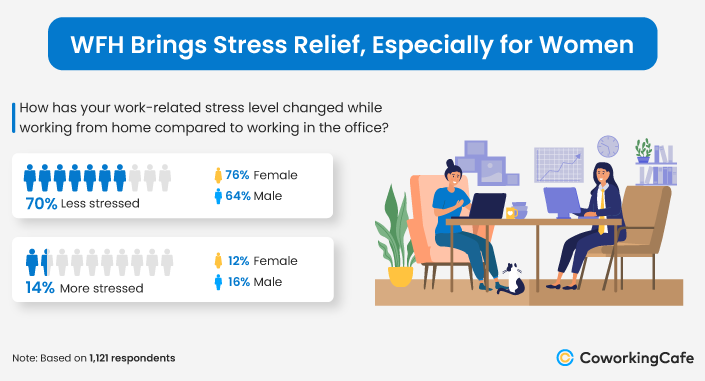
One of the clearest wins of remote work shows up in stress data. Seven in ten workers say their stress levels have declined since leaving the office behind (either completely or just part-time) and only 14% say stress has increased. Women report an even stronger improvement, more than three quarters felt less stressed while working remotely, compared to roughly two-thirds of men. For many women who carry a disproportionate share of household and caregiving responsibilities, remote work is a true pressure release valve.
Additionally, when asked to rate their mental well-being in the last 12 months on a 1-10 scale, most respondents landed comfortably on the positive side. In fact, roughly 77% gave a seven or higher, with the overall average landing at 7.7 out of 10. Generationally, Gen X registers the highest wellbeing (7.8), while Millennials clustered close to the overall mean. Gen Z appears to struggle the most with their mental health, falling notably lower, with an average of 7.3.
This dip among younger workers is a recurring theme throughout our survey, especially when it comes to isolation. While almost two-thirds of all respondents say they rarely or never feel lonely while working remotely, Gen Z stands out as less shielded from isolation. In fact, 20% of Gen Z experience high-frequency (1-2 times a week or more often) loneliness, double the rate reported by Millennials. Meanwhile, Gen X is the cohort that seems the most content not having to share their office with anyone else but their pets, with a whopping 69% saying they feel lonely less than once a month or never.
Burnout follows a similar pattern. A full 33% of survey takers experienced burnout symptoms such as emotional exhaustion, detachment and motivation dips in the past year. And even as overall stress seems to ease, burnout hasn’t gone anywhere. Gen Z feels it the most, with 38% reporting exhaustion, closely trailed by Millennials at 37%. Gen X stands out in the opposite direction: only 27% say they’ve hit that level of work-related strain, suggesting they may have found a steadier rhythm in the remote-hybrid shuffle.
Against that backdrop, it’s notable that a majority of companies seem to be aware of the mental-health load that their remote and hybrid workers are carrying. According to our survey, about 59% of employees say their workplace offers some form of mental-health support — whether that’s access to counseling services, wellness stipends, mental-health days or internal programs aimed at managing stress.
The Work-Life Tug of War: Balance Improves for 69% of Workers, yet 44% Still Log Longer Hours at Home
If burnout follows workers home, the question becomes whether they can actually unplug once the day is over. For most, the answer leans positive: two-thirds say it’s easy to disconnect from work, at least most of the time. But the ease of switching off isn’t shared equally.
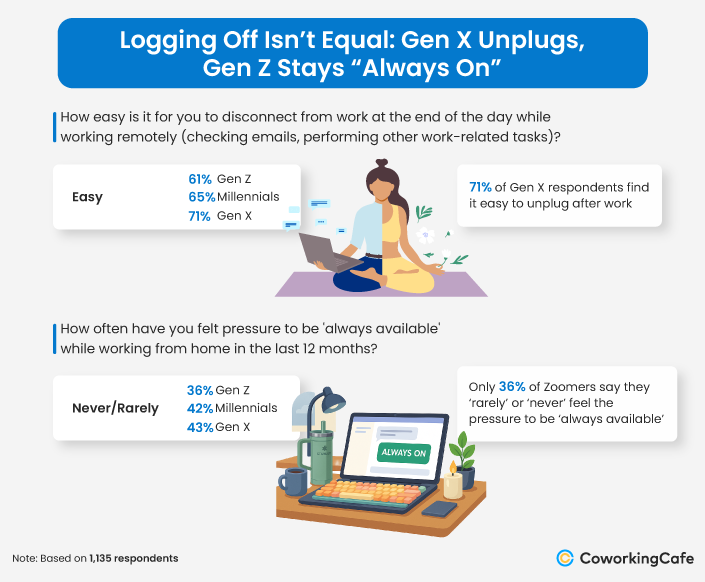 Gen X (again the steadiest group in this survey) finds it easiest to log out both mentally and digitally, while Gen Z struggles the most, with nearly one in five saying they can’t detach at the end of the day. Women also report slightly more difficulty than men, reinforcing a familiar pattern in remote-work research: the more roles someone juggles outside of work, the harder it is to draw the line*.
Even so, remote work seems to be doing what it promised for many people. Nearly 70% say their work-life balance has gotten better in the past year, with women reporting slightly higher improvements than men. Generationally, telework’s biggest perk is broadly felt, with everyone tracking fairly close — from Gen Z at 67% up to Millennials at 70%*.
That’s not to say the “always on” mentality just vanished into thin air. In fact, 58% of people report feeling at least some pressure to be constantly available — whether occasionally or frequently. Gen Z seems to bear the brunt of it. Just 36% of Zoomers say they “rarely” or “never” feel this kind of pressure, compared to 43% of Gen X*. It’s a noticeable gap that hints at a bigger story: younger workers might be pushing a little harder to stay visible in a remote world where presence is harder to prove than just being seen at your desk.
This pattern appears in working hours as well. Overall, 44% of workers say they’re putting in more time now than they did when working on-site. Gen X (48%) and Gen Z (47%) report longer weeks at similar rates, while Millennials are less likely to say their hours have increased. Millennials stand out for stability, with 44% reporting no change in hours, compared to 38% of Gen X and 34% of Gen Z*. That steadiness may reflect a middle-career sweet spot, where roles are well defined and expectations are clearer than for younger workers, while still carrying fewer senior-level demands that can stretch schedules at the top.
That said, it’s not all late nights and never-ending Slack notifications. While the workday may have stretched a bit, the hours saved from commuting and watercooler detours seem to be paying off where it counts. A whopping 61% of workers say they now have more room for family time or personal pursuits, arguably one of the biggest perks of remote life. And interestingly, this boost seems to be shared fairly evenly, with only small differences across age or gender*.
Remote Work Is Boosting Productivity but Gen Z Isn’t Completely Sold Yet
Ask remote workers how productive they feel these days, and most will tell you things are looking up. Nearly two-thirds (62%) say they’re getting more done at home than they did in their office days, while only 11% report a drop. But dig a little deeper, and the differences across age and gender start to stand out.
Productivity gains from remote work aren’t evenly distributed. Gen X stands out as the biggest beneficiary, with 68% reporting higher productivity, while Gen Z trails at 55% and is the most likely group to report a decline. That same dynamic carries over into gender differences, with women more likely than men to say remote work has boosted their output (66% versus 59%)*.
The same disparities pop up when it comes to focus. Over half of workers (55%) say it’s easier to concentrate at home, but women again come out ahead, with 62% reporting improved focus compared to just 49% of men. Gen Z struggles most: nearly one-third (31%) say it’s harder to stay focused remotely — almost double the rate of Gen X.
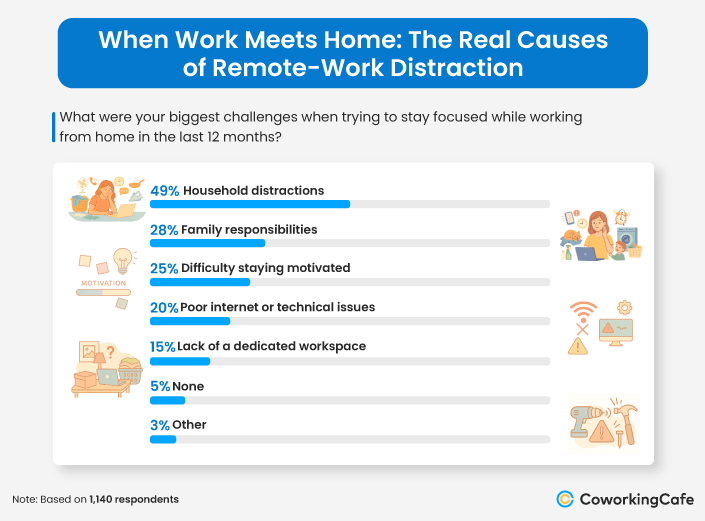 And when it comes to why focus is a challenge, the culprits are more practical than psychological. Household distractions (that include interruptions from others at home, domestic tasks and background noise) are the top barrier, cited by 49% of respondents. Family responsibilities follow at 28%, alongside waning motivation (25%), tech troubles (20%) and lack of proper workspace (16%). Just 4.6% of respondents say they have no trouble focusing at all.
Who’s Really Tech-Savvy? The Surprising Confidence Gap in Remote Work
Digital confidence — the ability to comfortably use, adapt to and troubleshoot remote work technologies — is holding strong. Workers rate their ease of adapting to remote tech at an average of 8.7 out of 10, and nearly half give it a perfect score. Interestingly, Gen X reports the highest confidence with digital systems, outpacing even Gen Z and Millennials.
While Gen Z is often seen as the “tech-native” generation, studies suggest that their strengths lie more in social and mobile technologies than in professional or enterprise tools. In contrast, Gen Xers, who’ve spent decades adapting to evolving workplace technologies, tend to show stronger digital literacy in remote work environments.
Another common myth about remote work? That it leaves people feeling disconnected or uncertain about their roles. But the numbers tell a different story: 75% of workers say they feel secure in their jobs and 78% report strong job satisfaction. In other words, remote employees aren’t just managing, they’re thriving.
What Remote Workers Value Most – and What They Would Improve
When asked what they enjoy most about remote work, most respondents pointed to one thing: no commute. Over a quarter (26%) said skipping traffic or train rides is the biggest perk. Gen X (31%) and women (28%) are the most likely to call out the time, energy and stress saved. Flexibility came next (15%), followed by autonomy (10%), home comfort (8%) and better focus (8%).
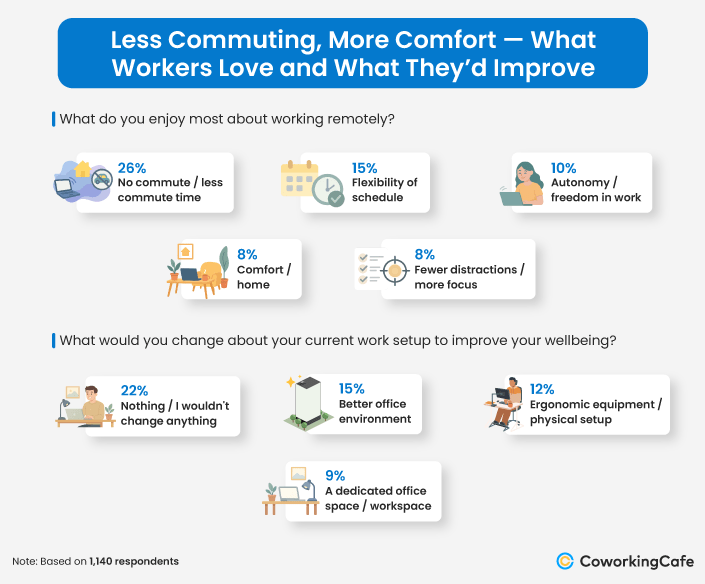 As for what they’d improve, 22% said nothing. But among the rest, the most common requests were practical: better chairs, more ergonomic setups, quieter spaces, stronger internet or a dedicated home office. These are simple fixes—not signs of dissatisfaction but signals that remote workers want comfort and support without sacrificing flexibility.
The RTO Red Line: Most Workers Would Consider Leaving
When asked how they’d respond to a full-time return-to-office mandate, the message from workers was hard to miss. Nearly 61% say they’d be likely to consider changing jobs, while just 23% say they’d be unlikely to do so.
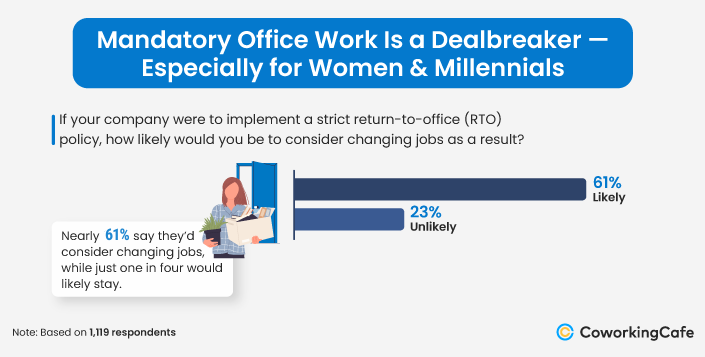
The pushback isn’t evenly distributed. Women are significantly more likely than men to view a mandatory RTO policy as a dealbreaker, with 65% saying they’d consider leaving, compared to 57% of men. Men, in turn, are more likely to say they’d stay put, with 26% reporting they’d be unlikely to change jobs, versus 19% of women. This gap hints at how inflexible office mandates may collide more directly with the routines and responsibilities women have built around remote or hybrid work.
Generational differences add another layer. Millennials emerge as the most resistant cohort, with 64% saying they’d likely look elsewhere if required to return full-time, a significantly higher share than Gen Z (53%) and slightly above Gen X (60%). Gen Z workers are the most uncertain, with nearly 23% saying they’re not sure how they’d respond, suggesting this group may still be weighing flexibility against early-career considerations. By contrast, Gen X appears the most settled, with responses clustering closer to the overall average.
In short, workers don’t interpret a blanket return-to-office mandate as a reasonable reset. As our data shows, remote work brought them valuable wellbeing gains, and when RTO policies ignore that, they’re not just raising eyebrows, they raise turnover risk.
Methodology
This report is based on an original survey conducted by CoworkingCafe between June 30 and October 10, 2025, targeting full-time U.S. employees aged 18 to 60 who work remotely to some extent, whether fully remote or hybrid. The goal was to better understand how remote work is shaping employee well-being, productivity, and attitudes toward office returns.
Data was collected via Clickworker and SurveyMonkey Audience, resulting in a total of 1,140 valid responses.
The sample includes respondents from Generation Z (296 respondents), Millennials (540 respondents), and Generation X (304 respondents), the three largest generational cohorts in the current workforce.
In total, 671 respondents identified as female and 469 as male, with representation across all three generations.
To ensure the results reflected the broader population of remote U.S. workers, responses were weighted by gender, generation, region, and industry (supersector) using benchmarks from the IPUMS Current Population Survey (CPS), January–August 2025 dataset. Sarah Flood, Miriam King, Renae Rodgers, Steven Ruggles, J. Robert Warren, Daniel Backman, Etienne Breton, Grace Cooper, Julia A. Rivera Drew, Stephanie Richards, David Van Riper, and Kari C.W. Williams. IPUMS CPS: Version 13.0 [dataset]. Minneapolis, MN: IPUMS, 2025. https://doi.org/10.18128/D030.V13.0
The margin of error is approximately ±2.9 percentage points at a 95% confidence level.
*No statistically significant difference based on two-sided tests with significance level 0.05