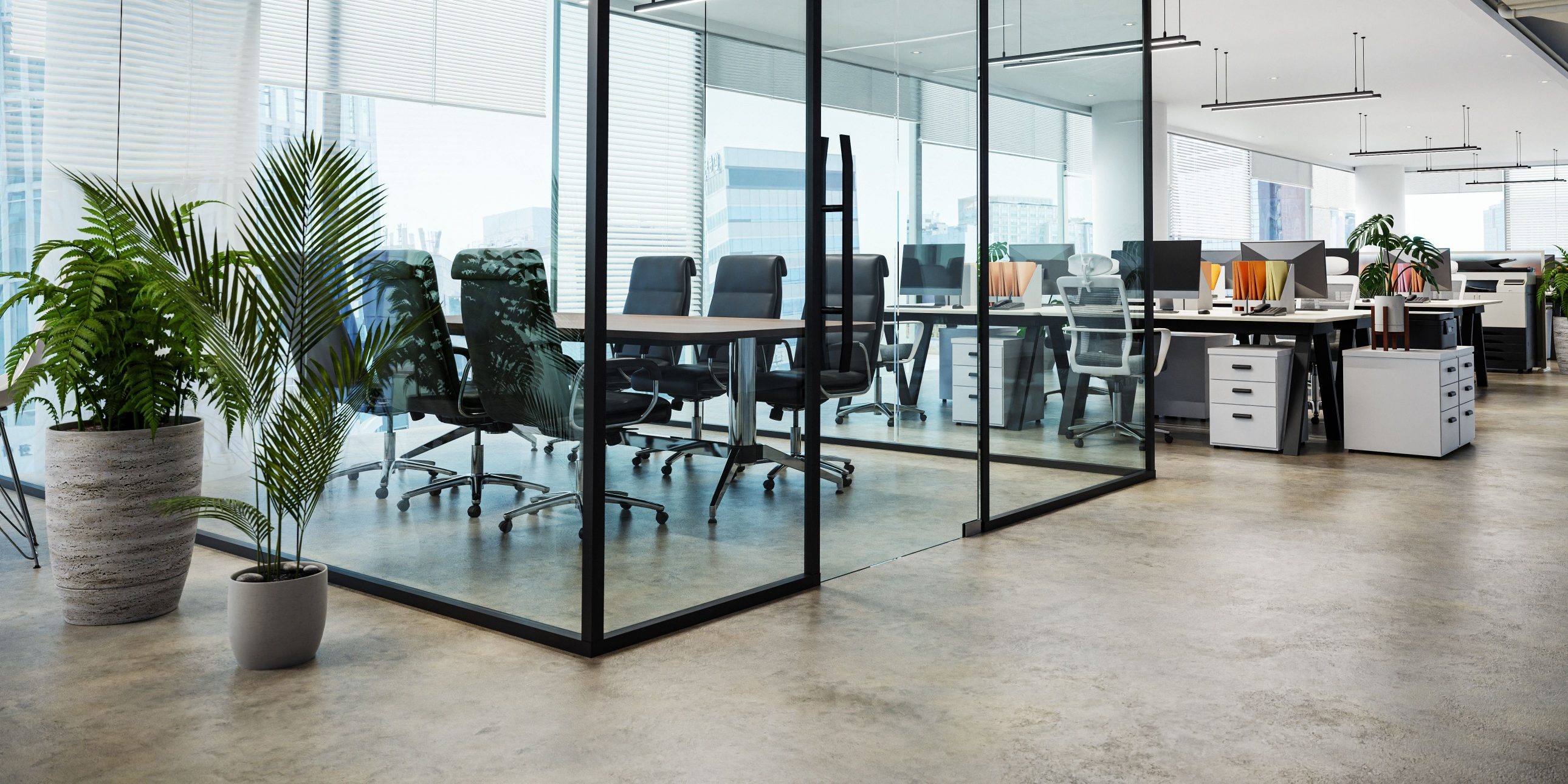
If you’ve been tasked with setting up a coworking hub for a team of up to 30 people, you’re facing a deceptively simple question: private office or open seating? The answer depends on how your team actually works, and a generic pros-and-cons list won’t help much.
We built a decision tree that maps the choice to seven practical signals: privacy requirements, call intensity, attendance predictability, team cohesion needs, equipment and storage, client-facing work, and budget flexibility. For many teams, the right answer is somewhere in between. A hybrid setup combines a small private office for call-heavy roles with open seating for everyone else, with a block of rentable meeting-room hours when privacy is needed.
Below, we give you the framework, the scoring matrix, realistic pricing anchors from our data, and an operator perspective so you can make this decision in minutes and defend it to Finance, HR, and leadership with confidence.
Private Office vs Open Seating: The Simplest Definitions
The terms vary by operator, but the functional differences are consistent.
What “Open Seating” Means (Hot Desk / Open Workspace)
No assigned desk. You arrive, pick an available seat in a shared area, and work alongside members from other companies. It’s sold as a monthly membership or a day pass, and there’s no guaranteed spot, permanent setup, or physical separation from the person three feet away. For booking etiquette, clean-desk policies, and storage workarounds, see our hot-desking guide.
What a Coworking Private Office Includes (and What It Doesn’t)
A lockable, enclosed room inside a coworking space, sized for one person up to 20 or more. You get dedicated desks, a closable door, and typically 24/7 access. Most include furniture, internet, and shared access to common areas, but everything else varies: soundproofing quality, meeting-room credits, phone booth availability, IT infrastructure, guest policies, storage, and minimum commitment term. Private offices are priced per office, not per seat, and the cost swings significantly by room size, floor, windows, included amenities, and market.
The Hybrid Setup (the Option Most People Skip)
A hybrid setup combines a small private office for roles that need daily privacy with open seating memberships or day passes for flex-schedule members, plus a block of meeting-room hours for scheduled calls and client presentations. This is the configuration our decision tree recommends most often, and the one most teams overlook because operators rarely package it as a single product.
The Decision Tree: Choose in 5 Minutes
How to read this: Start at Step 1 and answer honestly for your day-to-day work. When you hit a “Choose” result, you can stop. If you hit “Hybrid,” treat it as the default when your team needs privacy sometimes, not always.
| Step | Question | If YES | If NO |
|---|---|---|---|
| 1 | Do you regularly handle sensitive conversations (client confidentiality, HR, finance) that need to be private? | Choose: Private office (or Hybrid if only 1–2 days/week) | Go to Step 2 |
| 2 | Is call time a core part of your workday (sales calls, support calls, frequent video meetings)? | Choose: Private office or Hybrid (office + open seating + meeting rooms) | Go to Step 3 |
| 3 | Is attendance predictable (same people, same days) and do you need to sit together as a team? | Choose: Private office (team cohesion + shared rituals) | Go to Step 4 |
| 4 | Do you need to leave equipment or materials onsite (monitors, samples, files) or rely on a consistent setup? | Choose: Private office (or Hybrid with storage/lockers if available) | Go to Step 5 |
| 5 | Is your priority maximum flexibility and the lowest commitment (drop-in days, shifting headcount)? | Choose: Open seating (day passes or flexible membership) | Choose: Hybrid (privacy when it matters, flexibility elsewhere) |
Note: if your team is split on a step — five people are call-heavy and nine are not — that’s a strong hybrid signal. Also, “regularly” in Step 1 means at least several times per week, not once a quarter. And the tree assumes you’re evaluating coworking specifically, not comparing it against a traditional lease.
When Open Seating Wins

The Best-Fit Roles and Work Patterns
Open seating is the right call when your team’s work is primarily heads-down, laptop-based, and low on phone time. It’s a strong fit for:
- Individual contributors doing focused, quiet work (writing, design, analysis) who only occasionally need a call.
- Hybrid teams with unpredictable attendance, where you’d be paying for empty private-office desks most of the week.
- Early-stage or scaling teams where headcount shifts month to month and you need to add or drop seats without renegotiating a term.
- Teams that value networking and serendipity value open seating because it puts you in proximity to people from other companies, which matters for some roles (business development, partnerships, freelance work) more than others.
If your team’s privacy needs are genuinely low and attendance is variable, open seating is the lowest-commitment, lowest-cost-per-person entry point.
Open Seating Risks (and How to Reduce Them)
- Noise. Shared spaces can get loud, and the disruption costs more than we think. UC Irvine research found that people in interrupted conditions experienced a higher workload, more stress, and more time pressure. If even one team member has back-to-back calls on a Tuesday, they’ll disrupt, and be disrupted by, everyone around them.
- No guaranteed seat. Peak days (typically Tuesday through Thursday) can mean arriving to a full floor. Some memberships offer reserved or priority seating, but many don’t.
- No persistent setup. You pack up at the end of every day. External monitors, specialized hardware, or physical files make this impractical.
- Perception. A video call from a communal table with background chatter can undermine professionalism for client-facing roles.
To mitigate these, book phone booths or meeting rooms for calls (availability varies by space), use lockers for personal items, and establish a team clean-desk routine.
When a Private Office Is the Better Call

Confidentiality, Call-Heavy Work, and Team Cohesion
A private office earns its premium when the work itself demands enclosure:
- Confidential work is routine, not occasional. Legal, HR, finance, and healthcare-adjacent teams discussing sensitive information daily should not rely on phone booth availability at 10 a.m.
- Call intensity is high. Sales teams, customer success managers or recruiters will burn through meeting-room credits fast in an open seating setup. At that volume, a private office is cheaper and less disruptive.
- The team needs a home base. If the same six to twelve people come in on the same days and their collaboration depends on shared rituals (standups, whiteboard sessions, spontaneous check-ins), a private office provides that anchor.
- Equipment stays on-site. Multi-monitor setups, physical samples, secure documents, or anyone who can’t work efficiently from a laptop bag benefits from a dedicated and lockable space.
What to Confirm on a Tour (Sound, Access, Policies)
Not all private offices are created equal. Walk through these on-site before you sign:
- Soundproofing: Can you hear a normal-volume conversation from the hallway? From the adjacent office? Don’t rely the tour guide’s assurance here, test it yourself.
- Phone booth and meeting room access: How many are on the floor? Can you reserve them in advance, or is it first-come? Are any included in your office rate?
- IT and security: Shared or segmented Wi-Fi? Can you run a VPN reliably? Is there a wired ethernet option?
- Guest and client policy: Can clients visit without pre-registration? Is there a receptionist or check-in system?
- Storage: Are locking cabinets included, or an add-on?
- Expansion flexibility: If you need to go from 8 seats to 12 in three months, what’s the process? Is there a waitlist?
- Notice period and term: What’s the minimum commitment? What’s the penalty or notice required to downsize or exit?
These are non-negotiables, the details that determine whether a private office actually solves the problems you’re paying it to solve.
The Hybrid Setup Most Teams Overlook
Office + Open Seating + Meeting Rooms (Privacy on Demand)
Here’s the scenario that illustrates why hybrid deserves to be a default, and not an afterthought.
The team: 14 people — sales reps, customer success managers, and two engineers. Most are in-office Tuesday through Thursday. Wednesday is the heaviest day: eight or nine people, with sales and CS running client calls most of the afternoon.
What they think they need: A 14-person private office, five days a week.
What the decision tree actually recommends: A small private office (four to six seats) for the call-heavy sales and CS roles who are in daily. Open seating memberships for engineers and team members who come in two to three days a week. A standing block of meeting-room hours for Wednesday afternoon call surges and the occasional all-hands.
Why it works: Sales reps get soundproofing and a persistent setup. Engineers doing focused solo work get flexibility at a lower per-seat cost. The meeting-room block provides scheduled privacy without the overhead of a larger office. On Monday and Friday, when three or four people show up, the company isn’t paying for ten empty desks.
The result: Privacy where it matters, flexibility everywhere else, and a cost structure that scales with actual attendance rather than peak headcount.
One caveat: hybrid setups are harder to buy than they should be. Most operators won’t volunteer a split configuration — it’s more complex to quote and harder to fit into standard agreements. You may end up designing the deal yourself. That’s normal, and the five minutes of awkwardness are worth it.
Pricing and Budgeting Nuance (Using Our Data Anchors)

What Our National Median Pricing Tells You (and What It Can’t)
We track coworking pricing across thousands of U.S. locations. Use these as planning baselines, not quotes. From the U.S. Coworking Industry Report Q4 ’25 (listing data as of December 2025), national median starting prices per person:
- Open + dedicated desk memberships: $220/month
- Day passes: $30
- Meeting rooms: about $45/hour
- Virtual offices: near $159/month
These are median starting prices. Actual cost varies by market, operator, term length, and bundled amenities, and local listings on CoworkingCafe show where pricing lands in a given city. For private offices, we don’t publish a national median because pricing depends heavily on office size, window access, floor level, included credits, and minimum term. Ask operators for a per-office quote at your specific headcount and compare against the open-seating-plus-meeting-rooms alternative.
A Simple Cost Model to Compare Scenarios
Assume a 10-person hybrid team: 3 call-heavy roles, 7 flex roles. National medians as anchors.
Option A — Full private office for 10:
A single private office priced for your headcount. Request a direct quote. Simplest setup, highest fixed cost. You pay the same whether 3 or 10 show up.
Option B — Full open seating for 10:
10 memberships at $220/month = $2,200/month. Meeting-room hours for calls: if 3 call-heavy roles each need roughly 2 hours/day, 3 days/week, that’s about 72 hours/month at $45/hour = $3,240/month in meeting rooms alone. Total: approximately $5,440/month. The meeting-room math alone shows why high-call teams shouldn’t default to open seating.
Option C — Hybrid:
1 small private office (4 seats for 3 call-heavy roles plus buffer). Get a quote for 7 open seating memberships at $220/month = $1,540/month with a modest meeting-room block for overflow: 10 hours/month at $45 = $450. Private-office quote plus roughly $1,990/month. In most markets, this lands below Option A while providing better flexibility.
Model the hybrid alongside the extremes so you can see where cost-per-private-hour is actually lowest.
Operator Perspective: Why Products Are Structured This Way

Understanding the economics helps you negotiate smarter.
Open seating runs on over-subscription: more members than desks, because not everyone comes in every day. That’s what keeps per-person pricing lower. Private offices can’t be over-subscribed, so operators require more stable terms and charge accordingly.
The practical implication for buyers: hybrid configurations aren’t typically volunteered because they’re harder to quote and sell. You’ll likely need to ask explicitly and negotiate the components together. Independent spaces tend to be more flexible on deal structure than large operators running standardized pricing across portfolios.
Questions to ask before you sign (regardless of setup):
- Are meeting-room hours included in our rate, or billed separately?
- What’s the notice period to downsize, move, or exit?
- What are the expansion and contraction options if headcount changes in 3–6 months?
(For soundproofing, phone booths, IT, guest policy, and storage questions, see the tour checklist above.)
Scoring Matrix: Validate Your Decision
Once you’ve used the decision tree, run your situation through this matrix to confirm the result — and to create a shareable document for stakeholders who weren’t part of the initial discussion.
How to read this: For each factor, pick the column that best matches your reality. If 4+ rows point to one option, that’s your default. If it’s split, choose Hybrid and design the mix intentionally.
| Decision factor | Open seating (hot desk / open workspace) | Private office | Hybrid (office + open seating) |
|---|---|---|---|
| Privacy needs | Low / occasional | High / daily | Moderate / role-based |
| Call intensity | Light; calls are occasional | Heavy; calls are core work | Call-heavy roles need cover |
| Attendance predictability | Unpredictable, variable schedules | Predictable; same people most days | Predictable for some, not all |
| Team cohesion | Individuals or rotating members | Team needs a shared “home base” | Core team anchors, others float |
| Equipment & storage | Minimal; laptop-first | Needs secure storage/setup | Storage for key roles only |
| Client-facing work | Rare; use meeting rooms ad hoc | Frequent; privacy + professionalism | Meeting rooms + limited office use |
| Budget sensitivity | Highest sensitivity | Willing to pay for focus/privacy | Optimize cost per “private hour” |
| Growth & change | Headcount changes often | Headcount stable, predictable | Scaling expected but uneven |
If your matrix is split roughly evenly, the hybrid path is almost always the right call. It’s the setup designed for teams that don’t fit neatly into one box — which, in our experience, is most teams.
Executive Takeaway: What We Recommend Based on Your Signals
Choose open seating if your team is laptop-first, low on calls, variable in attendance, and budget-conscious. Use day passes or flexible memberships and book meeting rooms as needed.
Choose a private office if confidentiality is non-negotiable, call volume is high across most of the team, attendance is predictable, and you need a persistent physical setup. Confirm soundproofing, included meeting-room credits, and expansion options before signing.
Choose a hybrid setup — the default for mixed teams — if privacy needs vary by role, attendance fluctuates across the week, or you’re scaling and don’t want to commit to a fixed office size. Combine a small private office for call-heavy or confidential-work roles with open seating for everyone else and a standing block of meeting-room hours for overflow.
FAQ
Is a private office always better for productivity?
For focused, laptop-based work with minimal calls, open seating works fine — especially with quiet zones or bookable phone booths. A private office earns its keep when work requires consistent privacy, frequent calls, or the kind of team proximity where someone can tap a colleague’s shoulder instead of scheduling a meeting. One check worth doing: stand inside the office with the door closed while someone talks at normal volume in the hallway. That tells you more than any spec sheet.
When does open seating stop being cost-effective?
When your meeting-room bill approaches what a small private office would cost. If three team members are each booking two-plus hours of meeting-room time daily for calls, you’re paying for privacy twice. Get operator quotes for both setups and compare totals, not just per-seat sticker price.
Can we combine a private office with hot desk passes?
Yes. Many operators will sell a private office for a subset of your team and separate open seating memberships or day passes for the rest. It’s not always packaged as a single product, ask explicitly.
What should we ask about phone booths and meeting rooms before choosing open seating?
How many are on your floor, whether reservations are app-based or first-come, whether there are session time limits, and what peak-time availability looks like. Two phone booths shared among 80 members on a Wednesday afternoon won’t cover regular call needs.
How do coworking day passes compare to memberships for hybrid teams?
Day passes (around $30 at the national median) make sense for one to three days per month. Once someone is in eight or more days per month, a monthly membership (starting at $220/month for open + dedicated desk plans) is typically more cost-effective. The exact crossover depends on operator pricing and what’s included.
Do private offices usually include meeting-room credits?
It varies by operator and plan. Some agreements include a set number of hours per month; others bill separately. Clarify this before signing because included credits can meaningfully change the total cost comparison between a private office and open seating.