
You book the coworking day. You chase RSVPs. You pick a location that’s “easy for everyone.” You even pre-order coffee because you’re not a monster. And then… the day happens. Someone spends the morning reading updates out loud. Two people are stuck on video calls with teammates who didn’t come in. The agenda drifts. Everyone leaves with the same dull regret: we paid the commute tax for nothing.
Hybrid work didn’t reduce meetings. It changed what meetings cost. When a team is spread across cities, time zones, and schedules, “let’s just meet” is no longer a default. It’s a decision with real friction attached. If you’re the person who books the day, that’s the part you feel most — not in theory, but in calendar chaos, budget lines, and the quiet pressure of making it “worth it.”
Hybrid Work Is a Design Problem, Not a Policy
A hybrid team should meet in person when the work requires fast back-and-forth, clear emotional signals, or a real decision that won’t survive a week of comments. Stay async when the goal is sharing context, collecting input, or tracking progress.
The highest-performing hybrid teams don’t argue about office days. They design coworking days around outcomes, then book the space that fits the work.

Why hybrid meetings feel heavier now
Microsoft’s Work Trend Index found that 68% of people say they don’t have enough uninterrupted focus time in the workday. That’s the backdrop for every coworking day you try to plan. People are already stretched. So when you pull them out of their routine, the expectation — spoken or not — is simple: this had better move the work forward.
The other shift is messier but just as real. A lot of coordination now happens on the fly. The same reporting notes that 57% of meetings are ad hoc (no calendar invite) and one in ten scheduled meetings are booked last minute, a recipe for constant context switching. So if your in-person day becomes a pile of unstructured conversations and status updates, you’re not just wasting time. You’re stealing the one thing people keep saying they need: focus.
The biggest mistake: treating coworking like “the office, but rented”
Most disappointing coworking days share the same DNA: you booked a great space, but you didn’t design the day. A coworking space can’t save a bad agenda. A meeting room can’t fix unclear ownership. And a day office can’t rescue an interview process that’s improvised.
But the reverse is also true. When you design the day well, flexible space becomes an advantage. You’re not tied to a headquarters. You can pick a spot that fits the work — and stop paying for space you don’t use. You have choices. The real problem is knowing what and when to choose.
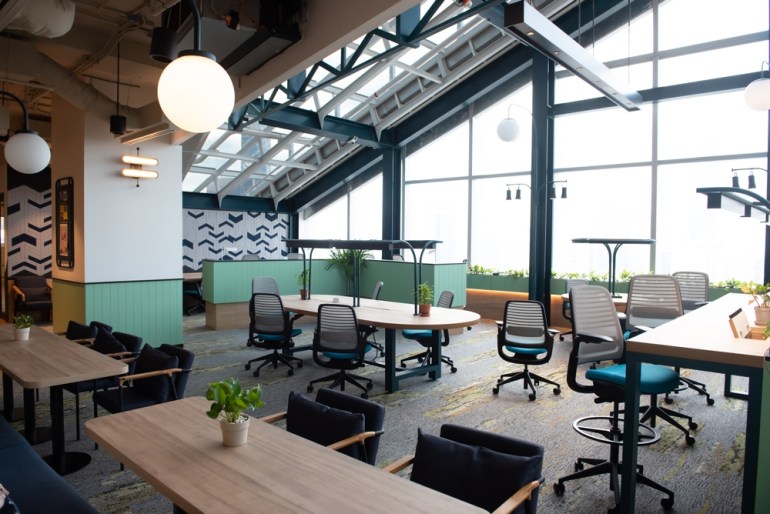
The “worth it” test before you book anything
Before you reserve desks, a meeting room, or a day office, force clarity with three questions:
-
What will be different by 4:00 p.m.? (A decision? A plan? A repaired relationship? A signed-off scope?)
-
What would take too long to do in writing? (If the honest answer is “nothing,” keep it async.)
-
Who has to be in the room for this to work? (If the answer is “everyone,” double-check that you’re not really doing status.)
If you can’t answer these quickly, don’t book the space yet. Do the async pre-work first.
The decision matrix (mode + space type)
Hybrid here means: async pre-work → short in-person block → async follow-through.
| Work Type | Best Mode | Why It Works | What to Book (If In-Person) | What to Do Async First |
|---|---|---|---|---|
| Status updates / weekly check-ins | Async | Updates don’t need real-time debate | Nothing (or desks for shared focus day) | Written updates + blockers + links |
| Brainstorming (collecting ideas) | Async | More input, less groupthink | Nothing | Prompt + idea doc + deadline |
| Brainstorming (merging ideas) | Hybrid | Async generates options; in-person merges fast | Meeting room (whiteboard + screen) | Cluster ideas + highlight open questions |
| Complex decisions | In-person or Hybrid | Tone + speed matter; misreads are expensive | Private meeting room | Decision memo with options + recommendation |
| Planning workshops | Hybrid | Shared context first; live alignment | Larger meeting room or event space | Pre-read + dependency map + risks |
| Design reviews / critiques | Hybrid | Async feedback first; in-person resolves conflict | Meeting room (screen + sketch space) | Share work 48h early + questions |
| Retrospectives | Hybrid or In-person | Psychological safety improves with presence | Private meeting room | Collect feedback (optionally anonymous) |
| Conflict resolution / sensitive 1:1s | In-person | Text escalates; presence de-escalates | Day office or small meeting room | Write the issue + desired outcome |
| Onboarding / team reset days | In-person | Trust builds faster face-to-face | Desks + meeting room | Send norms, docs, “how we work” guide |
| Hiring (final rounds) | In-person | Candidate experience + clarity improve | Day office or small meeting room | Scorecards + structured questions |
Booking the right space is part of the decision
The collaboration mode doesn’t just tell you whether to meet. It tells you what to book. If the goal is focus, you should book desks, not a room. There’s a version of coworking day that works brilliantly and looks unimpressive on paper: everyone comes in and works. No forced bonding. No meeting marathons. Just deep work, shared lunch, and fast answers.
If the goal is a decision, book a meeting room. You need a door you can close and a whiteboard you can use. Not a table near the espresso machine. If the goal is privacy, book a day office. Sensitive 1:1s, interviews, compensation conversations — these deserve space that protects candor. The space should support the work. Not fight it.

What to look for before you hit “reserve”
You don’t need a 30-point checklist. Avoid predictable failures:
-
Room size that matches real headcount
-
Reliable A/V (screen, cables, strong Wi-Fi)
-
Breakout options (phone booths, smaller rooms)
-
Real privacy (not performative privacy)
-
Low arrival friction (transit, parking, building access)
Hybrid-ready spaces today are designed for transitions — calls, breakouts, resets — not just desks.
A coworking day agenda that doesn’t collapse into “Zoom in a nicer chair”
Your coworking day should have a job. A simple structure works because it respects attention:
-
Start with one alignment block
-
Do the hard work in two focused blocks
-
Leave space for actual work
| Time | Block | Goal |
|---|---|---|
| 9:30–10:00 | Arrival + coffee | Settle in, no agenda drift |
| 10:00–10:20 | Silent pre-read | Everyone reads the same decision memo |
| 10:20–11:30 | Decision block #1 | Priorities + trade-offs |
| 11:30–12:00 | Break + sidebars | Resolve small knots quickly |
| 12:00–1:00 | Lunch | Build rapport naturally |
| 1:00–2:00 | Decision block #2 | Scope + dependencies + ownership |
| 2:00–4:00 | Work block | Pairing, drafting, follow-ups |
| 4:00–4:20 | Wrap | Decision log + next steps |
Notice what’s missing: status presentations. If someone needs context, they should read it before the day, not watch it performed live.
Async is still the foundation (and there’s data behind it)
A good hybrid system treats async as the default and in-person time as the sharp tool used on purpose. Hybrid can work. But it works best when you stop trying to recreate office life and start designing a rhythm: async for momentum, coworking days for the moments that genuinely benefit from being together.
The next time you book a team day, make it earn the commute
If you’re the person booking the day, you’re not just picking a location. You’re deciding how the team spends its rare shared hours. Use the matrix. Do the pre-work. Book the space that matches the job. If the meeting won’t change anything, don’t make people commute for it.