Mara Hauser didn’t set out to reinvent suburban coworking. She arrived there by design. Trained as an interior designer and later working in consulting, Hauser spent the early 2010s helping large enterprises rethink how and where people work. Long before “corporate coworking” became a buzz phrase, she was already designing flexible, amenity-rich environments that encouraged collaboration and drew employees back into the office.
In 2014, she brought those ideas closer to home. Drawing on her own experience as a working parent in the Chicago suburbs, Hauser founded 25N Coworking. Today, 25N focuses on suburban locations designed for active professionals and parents seeking a productive workplace near where they live, without sacrificing design, technology, or community.
In this interview, Hauser shares how her design background shaped 25N’s suburban model, what’s changed in workspace planning since the pandemic, and where she sees the next phase of suburban coworking heading.
 You began your career as an interior designer and then in consulting, before founding 25N Coworking in 2014. What was the moment you realized the suburban coworking model needed to exist—and how did your design background give you an early edge?
My design practice was developing models for new ways to work with enterprise or Fortune 100 companies, and in the 2010’s we were very focused on creating shared workplace environments with flexible offerings for the employees’ new work styles with a high need for collaboration. It was the beginning of corporate coworking. It worked! Employees were very engaged, they loved to come into the office, they loved the new amenities.
The 25N model was developed from a desire to bring the productive, inspiring and collaborative workplace environments to not 300 employees, but 300 independents who needed a workplace close to where they lived, in their neighborhood, where they could network and build their businesses around others doing the same. All with the aesthetic of a downtown corporate office. I participated in the Goldman Sachs 10,000 Small Businesses program. I was in the 4th cohort in Chicago, that’s where I developed the Growth Plan and the Business of 25N Coworking.
25N’s founding thesis is “workspace close to home for active parents and professionals”—how did you approach identifying your target member profile in the suburbs, and how has that profile evolved since the pandemic?
The founding thesis was really based on what I saw the need was for myself (and those of my friends, colleagues, and other soccer parents). The demographics for the Chicago suburbs we targeted were working parents who were active themselves with active children.
There was a need to have a workplace that they could walk in the door and forget about any of the tasks needed at home, but easy to get to after dropping off the kids at school, and able to easily get them to a soccer game while in between getting their most productive work done around others. A life-work balance. Individuals or businesses often did not have the technology needed nor a decent home office setup. They were taking over dining rooms, basements, or even garages. The commute to downtown was long. Or they had an existing office space that did not have the amenities or hospitality services that 25N offered.
After the pandemic, home offices became more efficient, dedicated space away from the family, and the best technology became more available. Our suburban locations still target the same active parent and professional but understand that now on average 50% have another “place” to work other than 25N be it at their home office or an HQ. We have enhanced our range of offerings for new targets, those who now need in person, hybrid, or virtual meetings and events with the best collaboration tools, technology, and food/beverage services.
What do you now look for when site-selecting a suburban build-out?
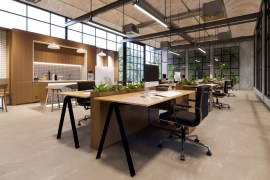
Originally, we started with 12,000 – 15,000 square feet and our spaces were approximately 80% open. Our current model is between 20,000 – 25,000 square feet with 80% enclosed spaces. We design quality amenities and meeting spaces in buildings that offer complimentary amenities and easy parking. We love to be in a vibrant central business district with good walkability to nearby restaurants, shopping, and personal services.
Suburbs vary dramatically—some are commuter towns, others are independent economies. What are some key factors that you look for when choosing a neighborhood?
In choosing a neighborhood, we specifically look at household income, types of housing, we look at drive/bike/walk options, we meet with the city’s Economic Development Departments, learn about the other businesses from the local Chamber of Commerce, and just look for a certain “vibe”.
What are the biggest challenges you face when getting a new location ready for open, both from a build-out perspective and from a client acquisition point of view?
Our biggest challenge has been balancing the investment for build out, FF+E and startup costs. Because of our design team and focus we are able to work very closely with vendor partners for building materials, furniture and fixtures to design creative, quality solutions at the right price point. Another challenge is the timeline from site selection through move in. 25N is fortunate to have a dedicated design/construction team, a launch team, and an all-hands-on deck culture. We have been able to open a new location in less than 60 days, but that is hard! Client acquisition at opening is very different than when you have 9 months of build time to build your membership as well.
You describe 25N as a hospitality-driven workplace design. What are some key factors that you look for when choosing a neighborhood?
Our goal is to support earnest professionals with productive, joyful workdays close to home. Walkability, residential properties walking distance or close by, parking, great restaurants or ability to bring in good food/catering, health and wellness services, shopping and a view!
From a design standpoint, what did you stop building after 2021, what did you double-down on, and which workspace typologies are currently undervalued by the broader flex industry?
After 2021 we decreased the open area spaces so there were not so many seats in one open space. We have since created neighborhoods or smaller open spaces even with the same headcount in a property, but not all in one area. After 2021 we increased the number of phone booths per property and rotated the view from the laptop to be Video call “ready”. We have added larger flexibly furnished training rooms to our offering. We have also mixed in productive working lounge spaces and continue to use single-sided and double sided booths. Thoughtfully designed spaces with a product mix of products are still undervalued in the flex industry.
From your dual lens of designer and operator, what’s the #1 design-error you see coworking operators make, and the #1 business-mistake you see designers overlook when entering the flex market?
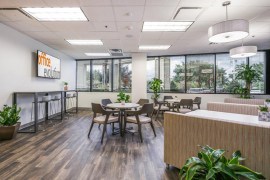
The #1 design error I see coworking operators make is using all of the exterior windows for private office space vs opening up some of the exterior windows to a café or places where community can gather either with desks, lounge, or other common areas.
The #1 design error designers just entering the flex market industry make is not understanding the difference between employees using an office vs multiple different businesses in the same space working alongside each other. There are special IT, security, acoustic and privacy regulations and needs.
In general, there is not a true understanding of the overall operational and physical needs for changing configurations of meeting rooms (sometimes hourly), office layouts changing constantly (adding desks or reconfiguring for function), and also assuring there are sight lines for the community team to meeting rooms for servicing. Overall, there needs to be an understanding that the overall product mix and space plan drives revenue.
Looking ahead: Pick one member-ritual, event or design feature that you believe will define the next decade of suburban coworking—and tell us why.
The design feature for the next decade of suburban coworking is to design a space for easy access close to home with in and out 24/7 where you can grab a desk, plug in, and pour great coffee. Work where you want, when you want. Simple, flexible, smart design.
Lightning round
The most underrated amenity in 2025.
Quiet zones – phone booths, wellness rooms, ROOM pods
One design decision that boosted ROI and member satisfaction at 25N.
Ultimate flexibility – modular and reconfigurable furniture and tech solutions
The best lesson you borrowed from enterprise workplace design and took with you into coworking.
User centricity – adaptive spaces with zones. Quiet, lounge, collaborative. Creating community in amenity and common spaces where you plan for people to purposely come together to make connections.