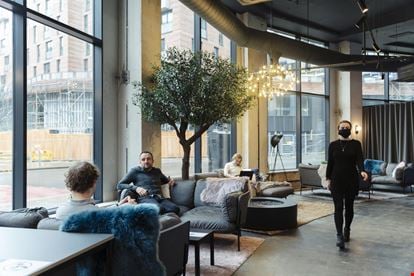
Complimentary coffee & tea
On-site café
High-speed internet
Bike storage

Day Pass

Meeting Room

Private Office

Dedicated Desk
24/7
24/7
24/7
24/7
24/7
24/7
24/7
Jan 16 2026
Really kind staff.. Really helpful
Jan 08 2026
An easily navigable station with helpful staff. I just wish they had shops after the ticket barrier as it would be helpful if you are making a connecting train at Manchester Piccadilly and want to get a snack between trains.
Jan 03 2026
Manchester Piccadilly is the main railway station of the city of Manchester, in the metropolitan county of Greater Manchester, England. Opened originally as Store Street in 1842, it was renamed Manchester London Road in 1847 and became Manchester Piccadilly in 1960. Located to the south-east of the city centre, it hosts long-distance inter-city and cross-country services to national destinations including London, Birmingham, Nottingham, Glasgow, Edinburgh, Cardiff, Bristol, Exeter, Plymouth, Reading, Southampton and Bournemouth; regional services to destinations in Northern England, including Cleethorpes, Liverpool, Leeds, Redcar Central, Sheffield and York; and local commuter services around Greater Manchester. It is one of 19 major stations managed by Network Rail. The station has 14 platforms: 12 terminal and two through platforms (numbers 13 and 14). Piccadilly is also a major interchange with the Metrolink light rail system with two tram platforms in its undercroft. Manchester Piccadilly is the busiest station in the Manchester station group (the other major stations in Manchester are Manchester Oxford Road and Manchester Victoria). As of December 2024, it is the second-busiest station in the United Kingdom outside of London (after Birmingham New Street),[2] and is also one of the busiest interchange stations outside London, with over 2 million passengers changing trains annually.[3] The station hosts services from six train operating companies. Between the late 1990s and early 2000s, Piccadilly station was refurbished, taking five years and costing £100 million (in 2002); it was the most expensive improvement on the UK rail network at the time.[4] Further improvements and expansion plans have been proposed. In December 2014, a Transport and Works Act application was submitted for the construction of two through platforms as part of the Manchester Piccadilly and Manchester Oxford Road Capacity Scheme.[5][6] In September 2019, Network Rail declared the Castlefield corridor through Manchester 'congested'.[7][8] Despite this, in 2023, these plans were withdrawn in favour of "a new approach", comprising upgrades to other stations in Manchester. Warrington West and do not call at Urmston or Irlam. Anglo-Scottish Route: 1tph to Carlisle, calling at Manchester Oxford Road, Preston, Lancaster, Oxenholme Lake District and Penrith North Lakes; of which: 1tp2h continue to Edinburgh Waverley, calling at Lockerbie and Haymarket 1tp2h continue to Glasgow Central, calling at Lockerbie and Motherwell. 1tph non-stop to Manchester Airport. Transport for Wales edit 1tph to Llandudno via the North Wales Main Line, calling at Manchester Oxford Road, Newton-le-Willows, Earlestown, Warrington Bank Quay, Runcorn East, Frodsham, Helsby, Chester, Shotton, Flint, Prestatyn, Rhyl, Abergele & Pensarn, Colwyn Bay, Llandudno Junction and Deganwy. Two trains per day run to Holyhead on weekdays only and some evening terminate at Chester. 1tph to Manchester Airport, calling at East Didsbury. 1tph to Cardiff Central via the Welsh Marches line, calling at Stockport, Wilmslow, Crewe, Shrewsbury, Church Stretton (irregular), Craven Arms (irregular), Ludlow, Leominster, Hereford, Abergavenny, Pontypool & New Inn (irregular), Cwmbran (irregular) and Newport. Alternate services continue either to Carmarthen, Fishguard Harbour, Milford Haven or Pembroke Dock.
Dec 05 2025
Such a large train station, doesn't even have a single rubbish bin. Disappointing :(
Nov 28 2025
So easy to find your way about :) Even to platforms 14&13 Staff were kind and informative, Felt verry safe,
London Road has a 24/7 availability that comes with a monthly membership. Hourly and day passes usually only allow for access during regular business hours.
Most, if not all, amenities are available to you as a member, regardless of the type of membership. Some shared spaces, like the meeting rooms, need to be booked in advance and private offices are only available for those with a subscription. However, all the other areas, like the lounge, kitchen and breakout spaces, are usable by every member. All complimentary services are available and anything ancillary can be purchased or negotiated with Department.
The open desk is the way to go if you’re looking for a flexible workspace in an open environment where you can socialize with other members. Or, choose a dedicated desk if you want a designated space that also allows you to keep in touch with the community.
A private office works wonders if you or your team need a quiet, secluded space to conduct your work and interact with people in your organization.
It’s important to understand the different types of coworking arrangements available to you, depending on the type of work that you do and its duration, and whether you’re a solo worker or part of a team.
Absolutely. Flexibility is one of the best parts of coworking. Most coworking memberships are month-to-month, so you can quickly adjust your space preferences according to your unique requirements and the size of your team. Whether that means upgrading the space or downsizing it or even completely changing the type of coworking subscription that you use, you always have the option to adjust as you go.
It may be possible to adjust your membership before current membership ends, but you will have to discuss and negotiate directly with Department, who is more than happy to help out.
Yes, you can certainly take a tour of the space before signing up for a membership. In fact, it’s encouraged, to help you get a feel for what your workday will look like. Schedule a tour here by filling out the form along with the date and time when you would like to visit the space and we’ll see you there.